
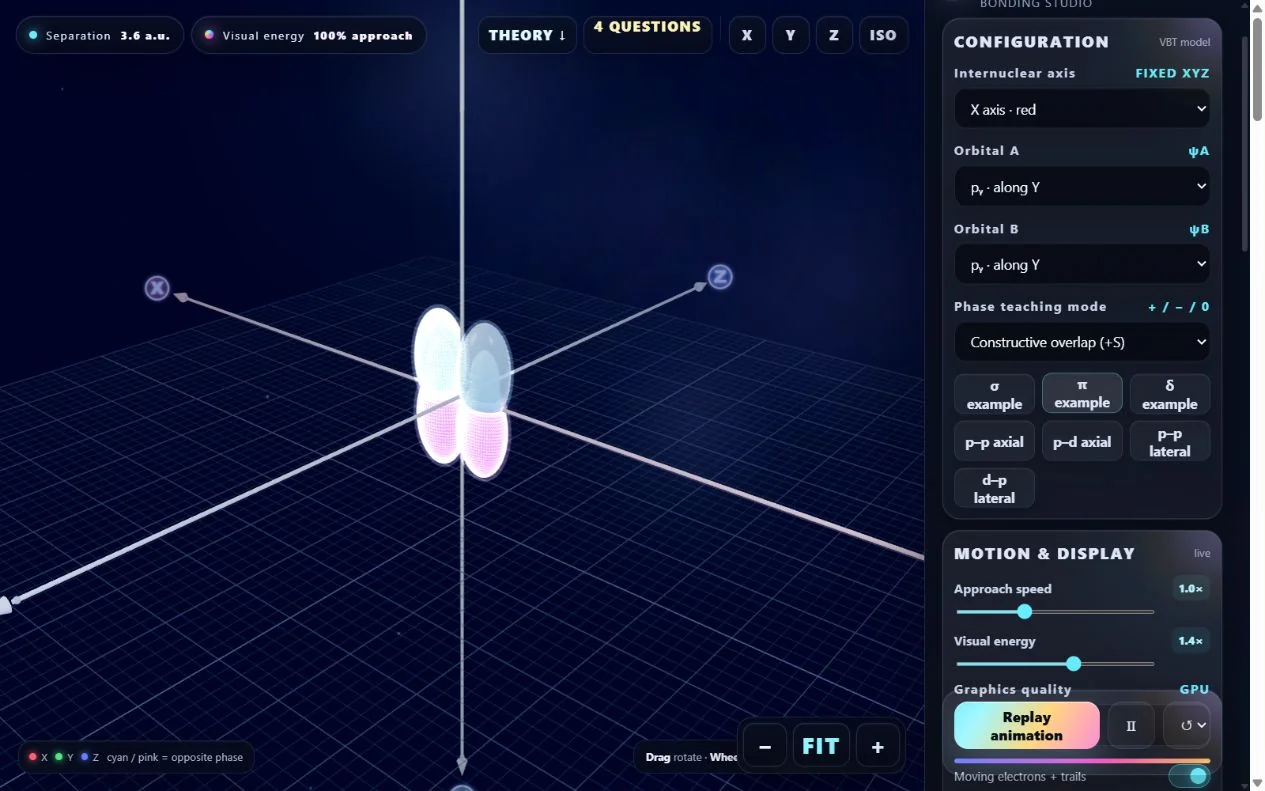
 LAB 01Free lab
VBT overlapping
Choose two s, p or d orbitals and an internuclear axis, then test whether their symmetry and phase produce σ, π, δ, mixed or no overlap.
SEE CHEMISTRY. UNDERSTAND MORE.
Step inside the chemistry you study. Rotate a molecule, explore an orbital and see how one small change transforms the whole picture.
Explore how orbital overlap and orientation shape a chemical bond.
Open full labTurn ideas into something visible.
Connect every model to the why.
Build confidence, one question at a time.
Pause, revisit and make it click.
YOUR NEXT DISCOVERY
LAB 01Free labChoose two s, p or d orbitals and an internuclear axis, then test whether their symmetry and phase produce σ, π, δ, mixed or no overlap.
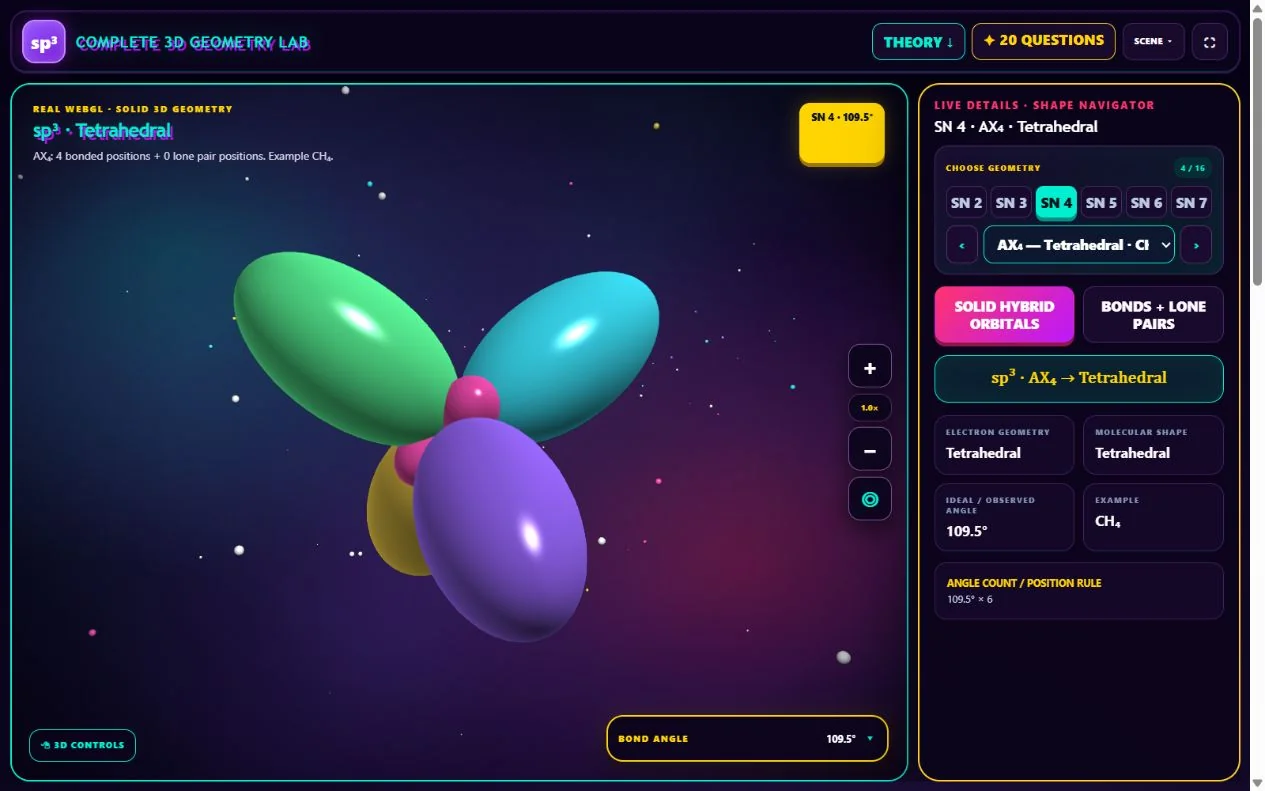 LAB 02Interactive lab
Explore solid hybrid orbitals and complete VSEPR geometries from steric number 2 to 7, then practise 50 foundation, core and advanced questions.
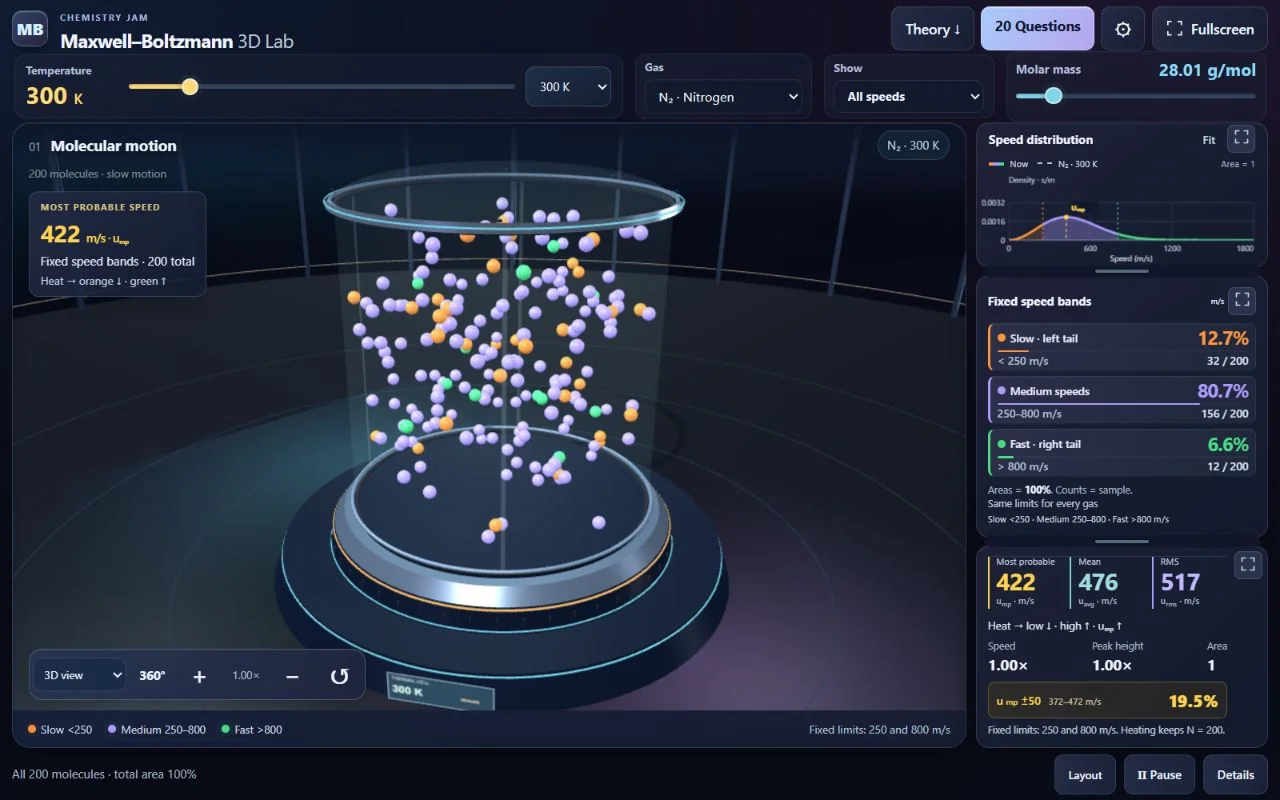 LAB 20Interactive lab
Explore molecular motion and speed distributions in 3D. Change temperature and gas mass, compare fixed speed bands and practise 20 questions with worked solutions.
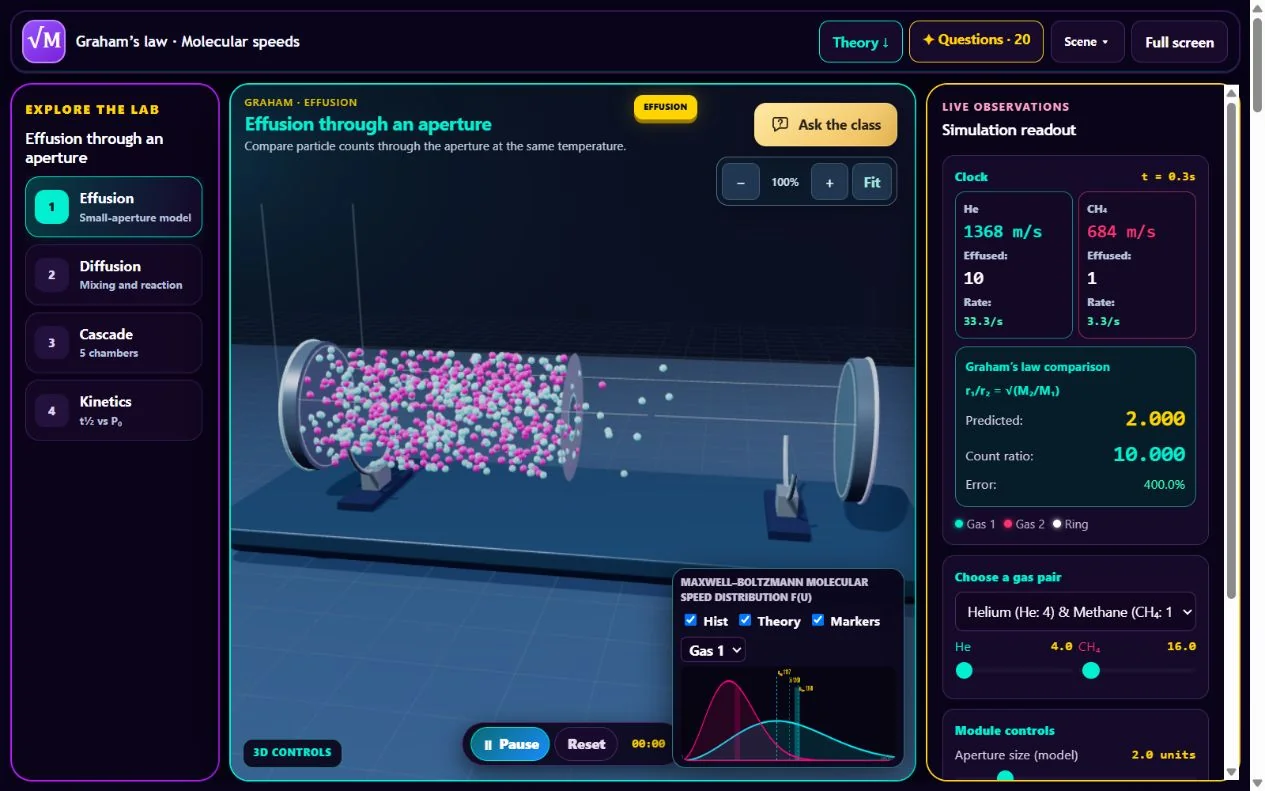 LAB 18Interactive lab
Compare effusion, diffusion and molecular-speed distributions in an interactive gas lab, then connect rate ratios with molar mass and temperature.
 LAB 17Interactive lab
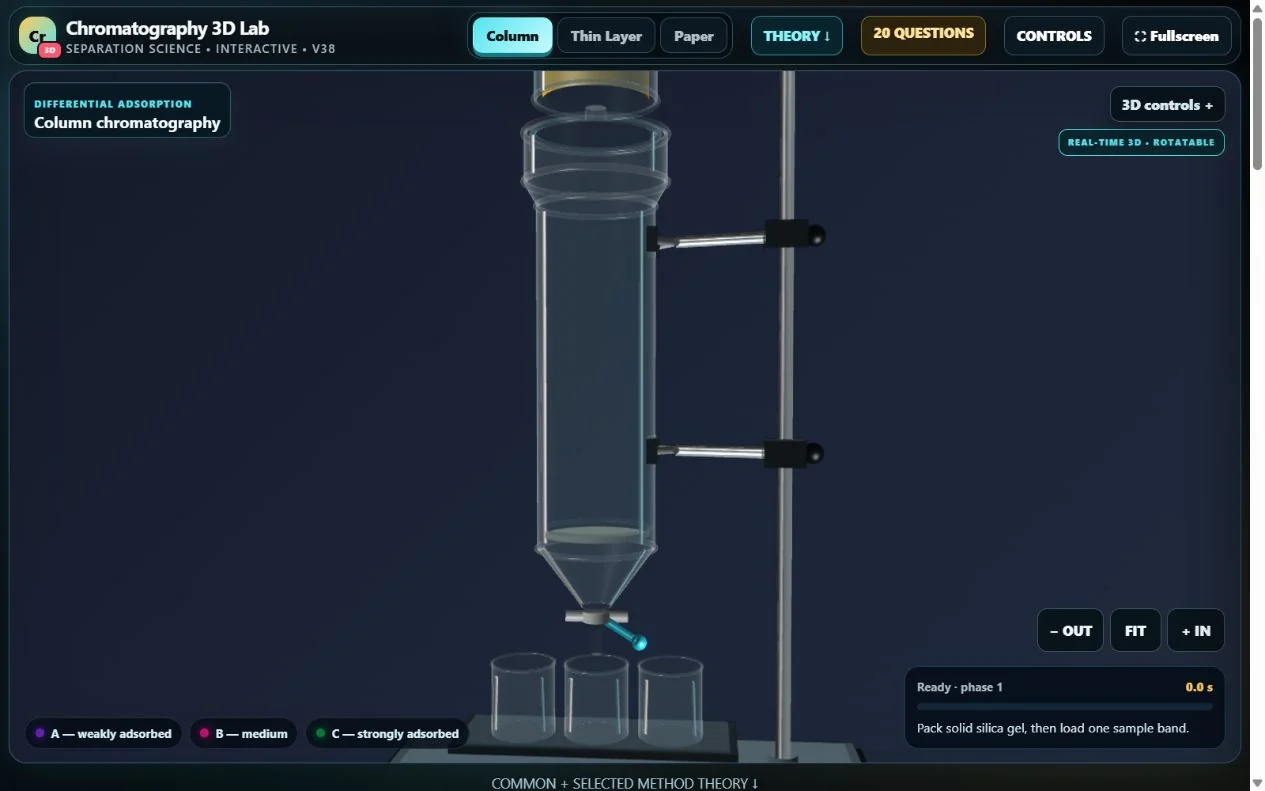
Run column, thin-layer and paper chromatography in 3D, compare stationary and mobile phases, and measure separation with an interactive Rf calculation.
 LAB 11Interactive lab
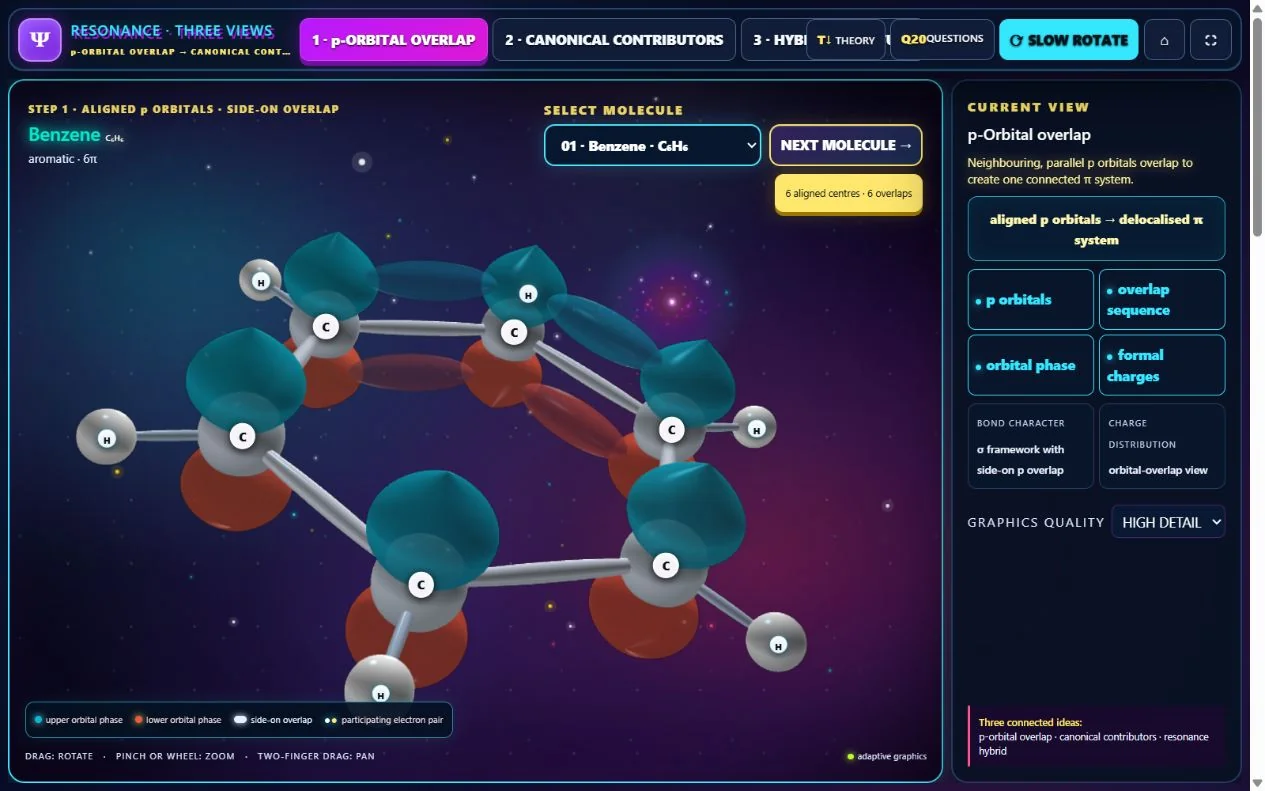
Connect aligned p-orbital overlap with imaginary canonical contributors and the real resonance hybrid across 23 important conjugated systems.
A BETTER WAY TO BUILD UNDERSTANDING
Bring the model, the explanation and the practice together. Every lab gives you a focused place to explore one concept.
Rotate, zoom and compare. Make the invisible easier to see.
Follow structured explanations, key rules and worked examples.
Try the questions and use the solutions to check your reasoning.
THREE BRANCHES. ONE CONNECTED SUBJECT.
Start with a topic you know. Discover the connections you haven’t seen yet.
TRY BEFORE YOU CHOOSE
Start with Fajan’s Rule, then explore VBT overlap and Schrödinger orbitals. No account needed.
FREE CHEMISTRY EBOOKS · JEE + NEET
Download Physical, Organic and Inorganic Chemistry notes. Three separate PDFs, clear chapter headings and colourful visual explanations. No sign-in needed.
LEARNING IS A CONVERSATION
Explore public learner comments, ask a question or tell us what could work better. Your feedback helps shape Chemistry JAM.
Try a free lab and join its discussion. Share what clicked, what surprised you and what you’d like to understand next.
TRUST & TRANSPARENCY
Try the labs, read learner feedback and find the details behind your purchase.
Lab pages show submitted star ratings and their count. A rating needs no name or written review.
Visitor feedback · not verified purchasesView ratings or leave yours ↗Razorpay handles payment details. Chemistry JAM does not store your card details or payment OTPs.
Security certifications apply to Razorpay’s service.View Razorpay certifications ↗See prices and billing periods before checkout. Genuine refund cases are reviewed individually; there is no automatic refund.
Manage subscription renewals in My Account.Read payment & refund help ↗Ask about access, report a chemistry correction or suggest an improvement.
contact@chemistryjam.comContact & support ↗POPULAR CHEMISTRY TOPICS
Chemistry JAM connects visual experiments with clear rules, guided observations and original practice. Open a focused concept below, manipulate the model and compare the result from foundation to advanced level.
Explore probability clouds, boundary shapes, radial nodes and angular nodes in a responsive 3D model.
Explore 3D concept →Compare sigma, pi and delta overlap while watching atomic orbitals approach and form bonds.
Explore 3D concept →Connect steric number, hybrid orbitals, lone pairs, bond angles and molecular shapes.
Explore 3D concept →Visualise why lower oxidation states become more stable down selected p-block groups.
Explore 3D concept →Follow lone-pair donation into a neighbouring vacant orbital and compare its structural effects.
Explore 3D concept →Move from canonical contributors to the real resonance hybrid through continuous orbital overlap.
Explore 3D concept →BUILT FOR LASTING UNDERSTANDING
LEARNING QUESTIONS
It is a browser-based visual model that lets you rotate structures, change variables and observe how a chemistry rule affects orbitals, bonding, geometry or periodic behaviour.
The library covers atomic orbitals, chemical bonding, hybridisation, molecular geometry, periodic trends, inorganic structures, resonance, stoichiometry and other physical, inorganic and organic chemistry concepts.
Yes. Chemistry JAM uses responsive controls, touch rotation, zoom and mobile-friendly layouts so the simulations can be explored on phones, tablets and desktop computers.
No. The simulations open directly in a supported web browser, so learners can study the models online without downloading the laboratory files.