
Effusion through an aperture
Effusion is the escape of gas particles through a very small opening. Under matched conditions, the molar effusion rate varies inversely with the square root of molar mass.
Opening your lab guide…
The simulation has closed. Your guide is on its way.
LIVE LAB 18 • STATES OF MATTER & KINETIC THEORY
Compare effusion, diffusion and molecular-speed distributions in an interactive gas lab, then connect rate ratios with molar mass and temperature.
Open paid simulation →Purchase this simulation or get all paid labs with a subscription. View prices →
 ACTUAL LAB PREVIEW
QUICK START
COMPLETE CONCEPT GUIDE
Connect particle motion with measurable gas behaviour. The lab compares effusion through a small aperture, diffusion in a tube, molecular-speed distributions and the effects of molar mass and temperature.
Effusion is the escape of gas particles through a very small opening. Under matched conditions, the molar effusion rate varies inversely with the square root of molar mass.
For gases 1 and 2 at the same temperature, pressure and aperture conditions, r₁/r₂ = √(M₂/M₁). The lighter gas therefore effuses faster.
Using rounded molar masses of 4 and 32 g/mol, helium effuses √(32/4) = √8 ≈ 2.83 times as fast as oxygen under matched conditions. For equal amounts, effusion times have the inverse ratio: tHe/tO₂ ≈ 0.354.
Diffusion is the net mixing produced by random molecular motion. Tube-distance comparisons use Graham’s relation as a simplified model under carefully matched conditions.
A gas contains particles with a range of speeds. Raising temperature shifts and broadens the Maxwell–Boltzmann distribution, while increasing molar mass shifts it toward lower speeds.
GRAHAM’S LAW FAQ
Under matched conditions, the effusion rate of a gas is inversely proportional to the square root of its molar mass.
At the same temperature, lighter gas particles have a higher characteristic molecular speed, so more of them reach and pass through a small aperture per unit time.
Effusion is escape through a very small opening, while diffusion is mixing caused by random molecular motion through space or another gas.
For a fixed gas, characteristic molecular speeds are proportional to the square root of absolute temperature.
RELATED SIMULATIONS
 States of Matter & Kinetic Theory
Explore molecular motion and speed distributions in 3D. Change temperature and gas mass, compare fixed speed bands and practise 20 questions with worked solutions.
Open related lab →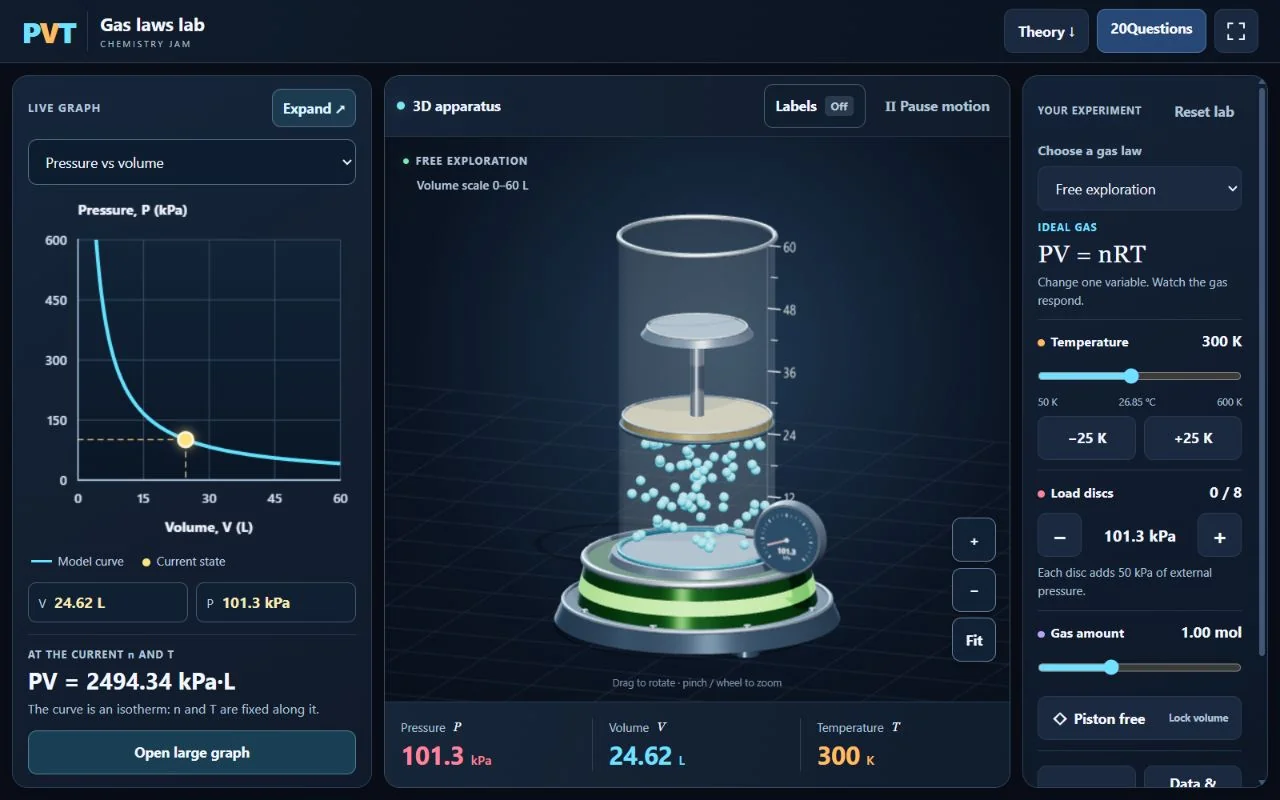 States of Matter & Gas Laws
Explore pressure, volume, temperature and amount in a live piston model, trace gas-law curves, collect data and connect macroscopic changes with particle motion.
Open related lab →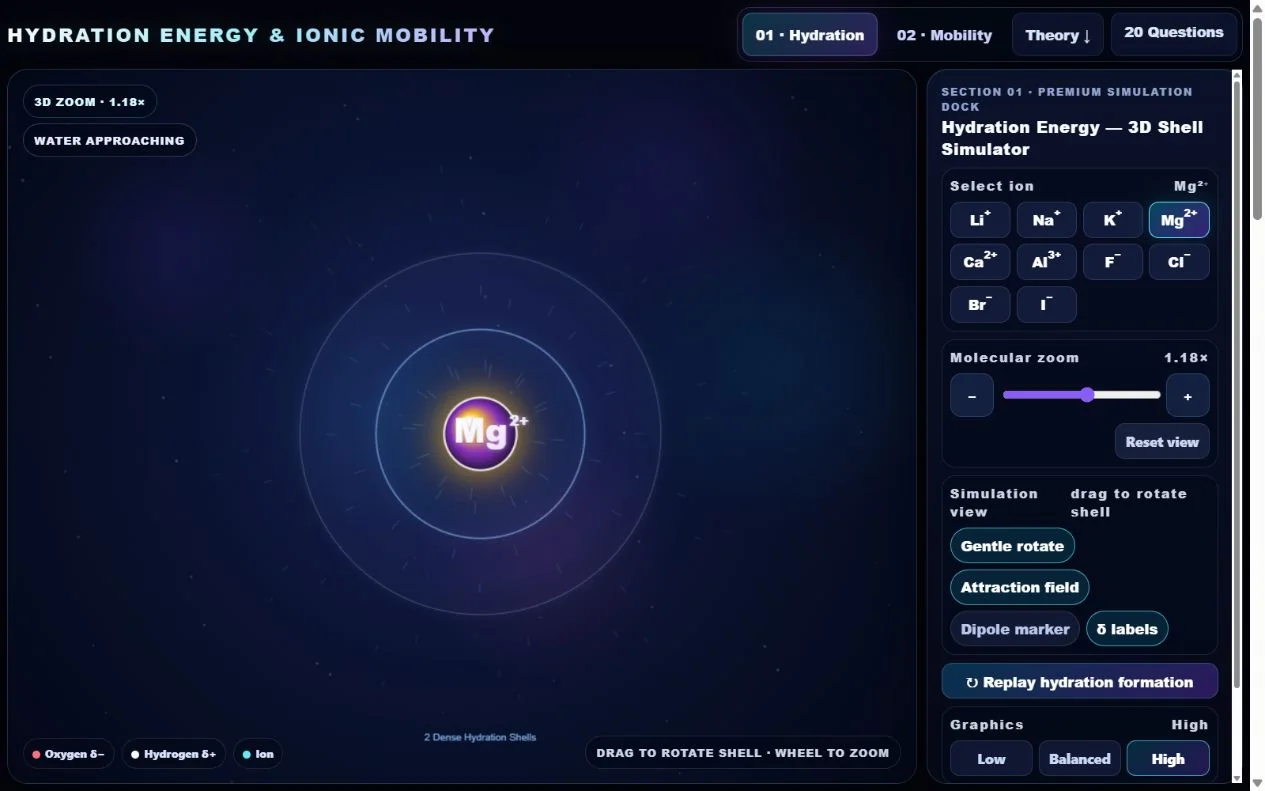 Electrochemistry
Watch water dipoles approach, orient and lock around an ion in a rotatable 3D hydration shell, then compare realistic hydrated-ion motion in an electric field.
Open related lab → Atomic Structure
Visualise effective nuclear charge as nuclear attraction minus shielding, apply Slater's rules across Period 2 and Group 1, and compare s, p, d and f penetration.
Open related lab →Connect this lab with related chemistry topics and choose the depth that fits your current studies.
STUDENT DISCUSSION
Loading discussion…
Comments stay outside the simulation. When you exit the lab, you can choose to share a question or observation.