
Meaning of hybridisation
Hybridisation is the mixing of atomic orbitals of comparable energy on the same atom to form a new set of directed hybrid orbitals. The number of hybrid orbitals produced equals the number of atomic orbitals mixed.
Opening your lab guide…
The simulation has closed. Your guide is on its way.
LIVE LAB 02 • CHEMICAL BONDING
Explore solid hybrid orbitals and complete VSEPR geometries from steric number 2 to 7, then practise 50 foundation, core and advanced questions.
Open paid simulation →Purchase this simulation or get all paid labs with a subscription. View prices →
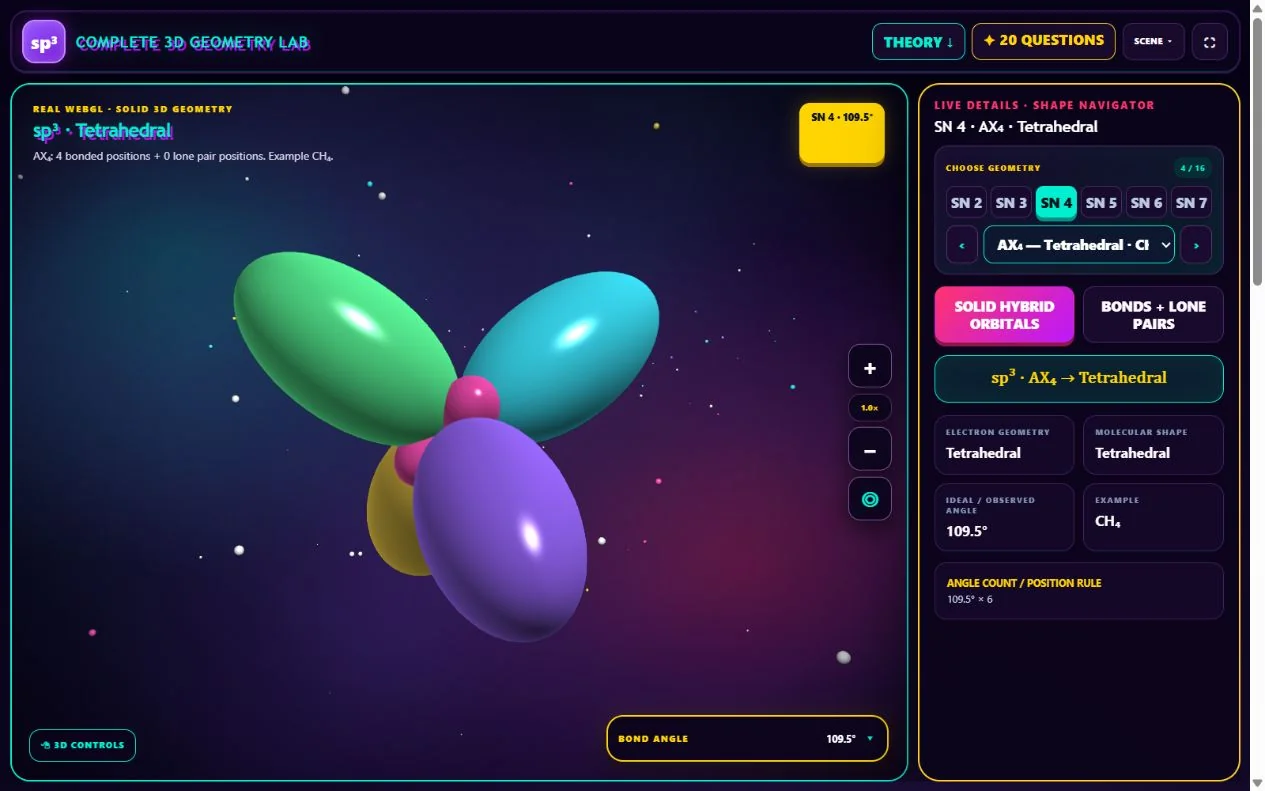 ACTUAL LAB PREVIEW
QUICK START
COMPLETE CONCEPT GUIDE
Learn hybridisation as a connected process: count electron domains, determine steric number, assign the conventional orbital type, distinguish electron geometry from molecular shape, and predict how lone pairs affect bond angles. The 3D lab covers steric numbers 2–7 and includes 50 original questions from foundation to advanced level.
Hybridisation is the mixing of atomic orbitals of comparable energy on the same atom to form a new set of directed hybrid orbitals. The number of hybrid orbitals produced equals the number of atomic orbitals mixed.
Draw the Lewis structure and count sigma-bond directions plus lone pairs on the central atom. Each single, double or triple bond counts as one electron domain for geometry, so steric number = sigma-bond domains + central-atom lone pairs.
In the conventional orbital model: SN 2 → sp → linear; SN 3 → sp² → trigonal planar; SN 4 → sp³ → tetrahedral; SN 5 → sp³d → trigonal bipyramidal; SN 6 → sp³d² → octahedral; SN 7 → sp³d³ → pentagonal bipyramidal.
Electron geometry includes every bond domain and lone pair around the central atom. Molecular shape names only the positions of atoms. Thus NH₃ has tetrahedral electron geometry but trigonal-pyramidal shape, while H₂O is tetrahedral electronically but bent molecularly.
The usual repulsion order is LP–LP > LP–BP > BP–BP. Lone pairs occupy more space than bonding pairs and often compress nearby bond angles, explaining the exam trend CH₄ > NH₃ > H₂O. In five-domain arrangements, lone pairs prefer equatorial positions first.
The conventional syllabus model labels five-, six- and seven-domain central atoms as sp³d, sp³d² and sp³d³. Use these labels for structured problems while remembering that the solid lobes in the lab are teaching models of orbital direction and electron-domain geometry.
Compare PCl₅, SF₄, ClF₃ and XeF₂ within steric number 5; then compare SF₆, BrF₅ and XeF₄ within steric number 6. The electron geometry stays fixed within each group while lone pairs change the visible molecular shape.
RELATED SIMULATIONS
 Chemical Bonding
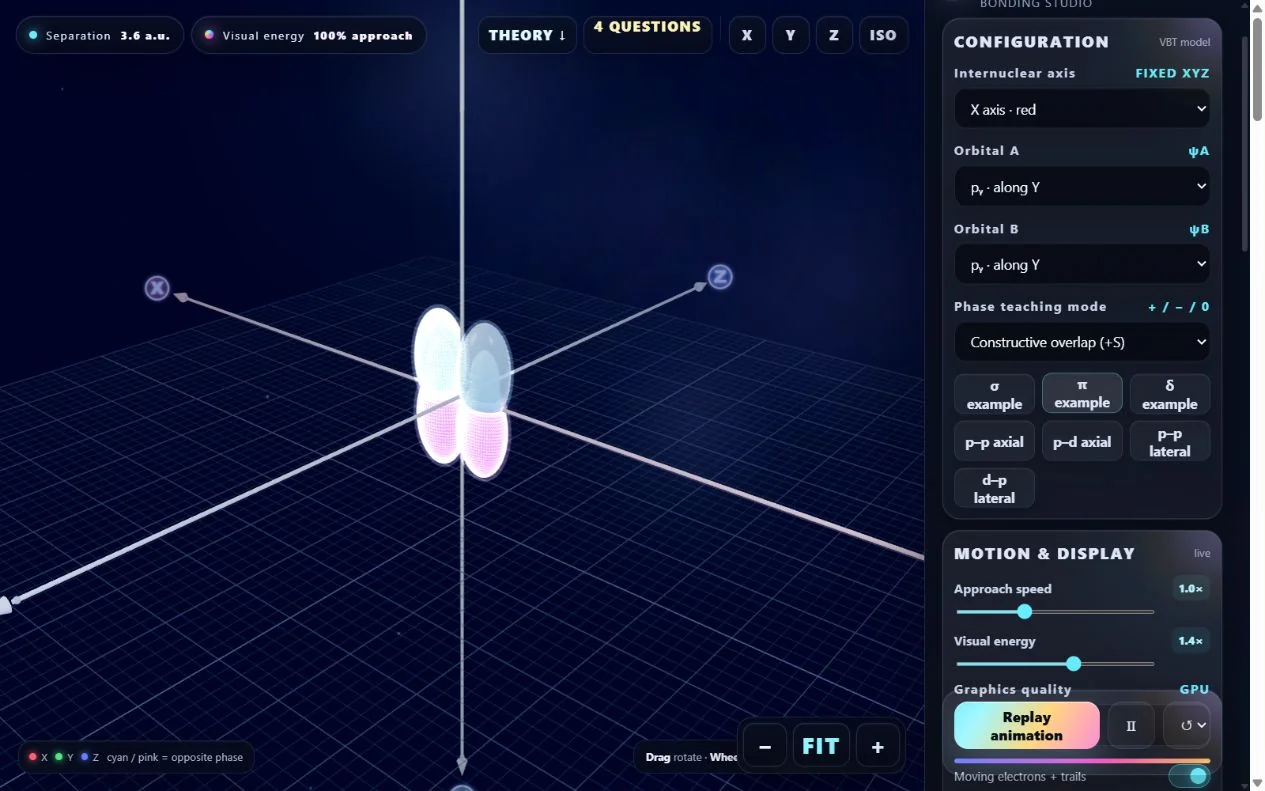
Choose two s, p or d orbitals and an internuclear axis, then test whether their symmetry and phase produce σ, π, δ, mixed or no overlap.
Open related lab →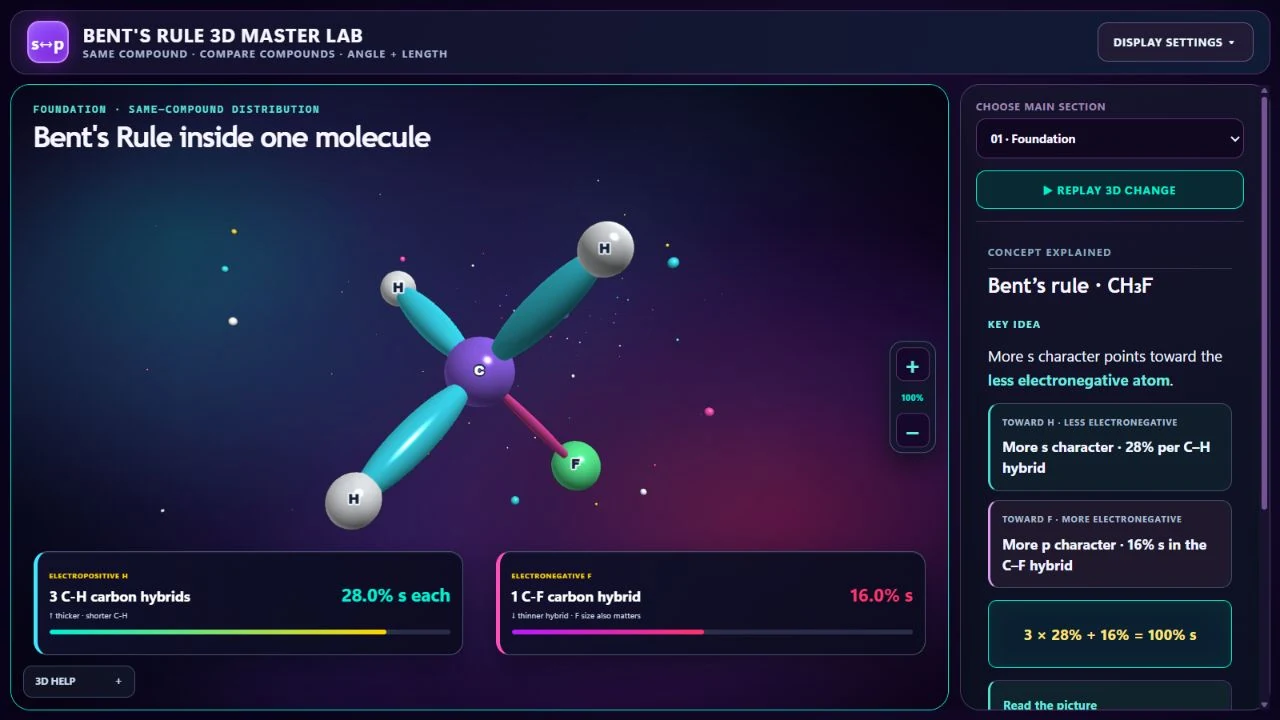 Chemical Bonding
See how central-atom s and p character redistribute between bonds, then connect hybrid character with angles, placement and bond length.
Open related lab →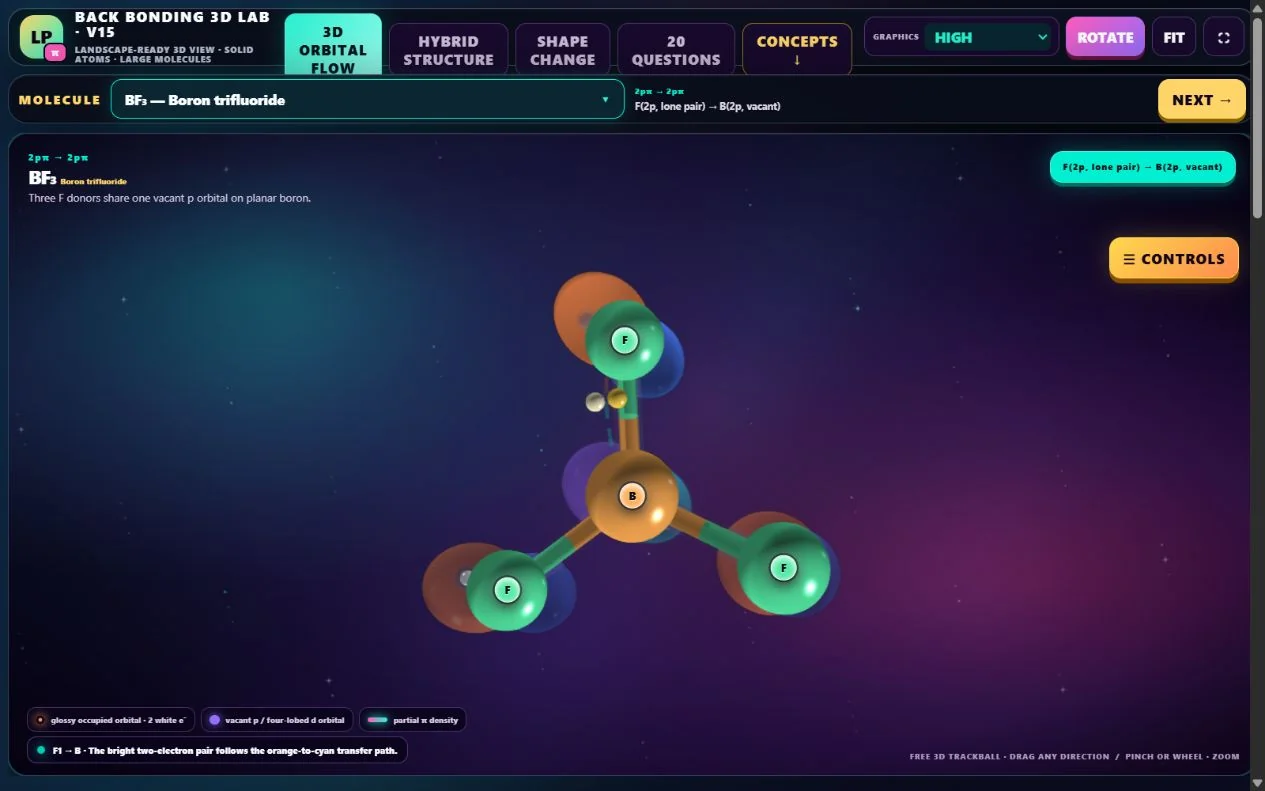 Chemical Bonding
Watch lone-pair donation into a neighbouring vacant orbital, compare 11 back-bonding systems, follow seven shape changes and solve 22 guided challenges.
Open related lab →Connect this lab with related chemistry topics and choose the depth that fits your current studies.
STUDENT DISCUSSION
Loading discussion…
Do not equate hybridisation directly with molecular shape. First determine the complete electron-domain geometry, then remove lone-pair positions only when naming the molecular shape. Also count a multiple bond as one direction, not two or three domains.
HYBRIDIZATION FAQ
Hybridisation is the mixing of atomic orbitals of comparable energy on the same atom to form directed hybrid orbitals used in the conventional bonding model.
Count sigma-bond directions and lone pairs on the central atom. Steric numbers 2, 3, 4, 5, 6 and 7 correspond conventionally to sp, sp², sp³, sp³d, sp³d² and sp³d³, respectively.
Yes. A single, double or triple bond points in one direction from the central atom, so it counts as one electron domain when determining steric number and VSEPR geometry.
Electron geometry includes bonds and lone pairs. Molecular shape considers only atom positions. For example, NH₃ has tetrahedral electron geometry and trigonal-pyramidal molecular shape.
Lone-pair–bond-pair repulsion is stronger than bond-pair–bond-pair repulsion. One lone pair compresses the H–N–H angle to about 107°, while two lone pairs compress the H–O–H angle to about 104.5°.
XeF₂ has five electron domains and is labelled sp³d in the conventional exam model. Its electron geometry is trigonal bipyramidal, while three equatorial lone pairs leave a linear molecular shape.
XeF₄ has six electron domains and is labelled sp³d². Its electron geometry is octahedral; two opposite lone pairs leave a square-planar molecular shape.
IF₇ has seven bond domains and no central lone pair. It is labelled sp³d³ in the conventional exam model and has pentagonal-bipyramidal geometry.
A lone pair occupies an equatorial position first because it has only two 90° interactions, compared with three 90° interactions at an axial position.
Comments stay outside the simulation. When you exit the lab, you can choose to share a question or observation.