
Head-on and sideways overlap
Sigma overlap is symmetric around the internuclear axis. Pi overlap has a nodal plane containing that axis; delta overlap has two. The classification depends on the orientation of the orbitals relative to the bond axis.
Opening your lab guide…
The simulation has closed. Your guide is on its way.
LIVE LAB 01 • CHEMICAL BONDING
Choose two s, p or d orbitals and an internuclear axis, then test whether their symmetry and phase produce σ, π, δ, mixed or no overlap.
Start free simulation →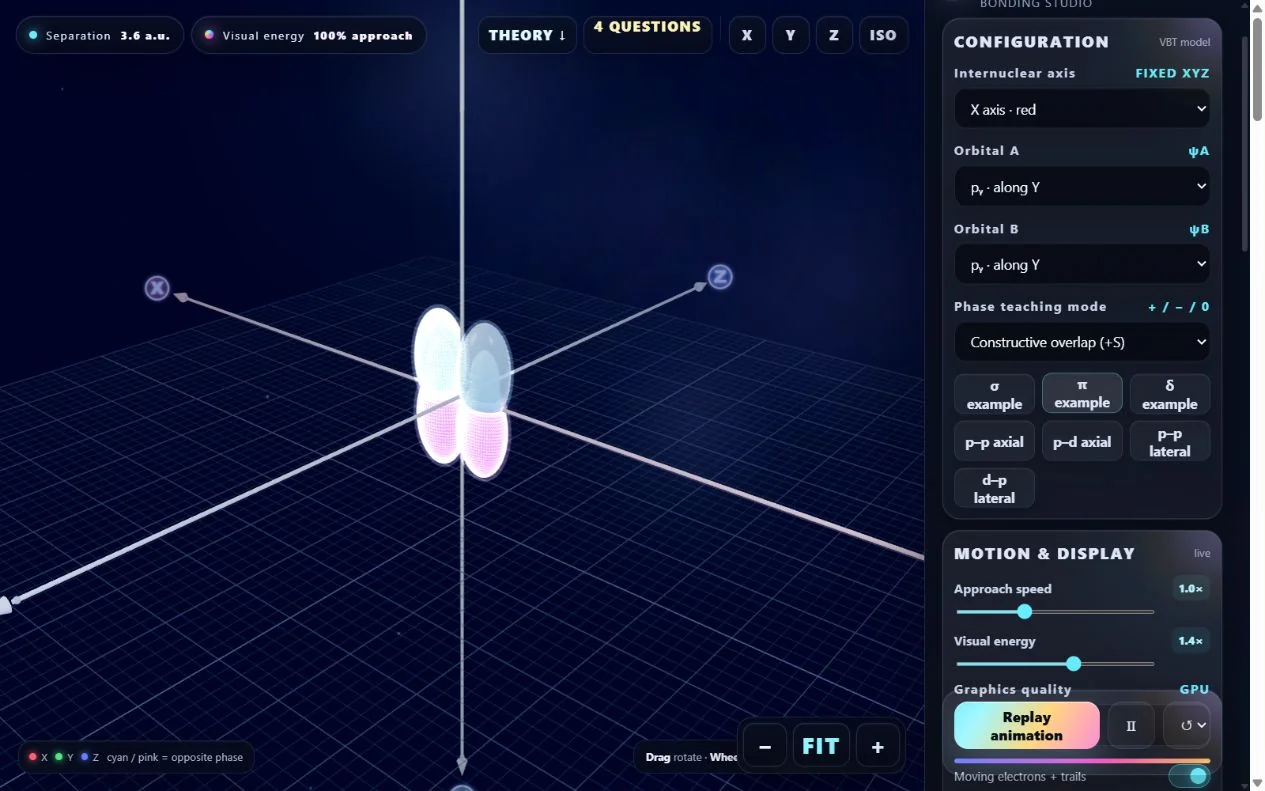 ACTUAL LAB PREVIEW
QUICK START
COMPLETE CONCEPT GUIDE
Valence bond theory connects a covalent bond with overlap between suitable atomic orbitals. Use the lab to change the orbitals and bond axis, then compare their symmetry before predicting the overlap type.
Sigma overlap is symmetric around the internuclear axis. Pi overlap has a nodal plane containing that axis; delta overlap has two. The classification depends on the orientation of the orbitals relative to the bond axis.
The colours of orbital lobes represent the sign of a wavefunction. Same-phase overlap can contribute constructively, whereas opposite-phase overlap can contribute destructively. A negative lobe does not mean a negatively charged region.
Select two p orbitals and keep them fixed while changing the internuclear axis. Compare an end-on arrangement with a side-on arrangement. Symmetry can make the net overlap vanish even when parts of the displayed shapes appear to meet.
VBT OVERLAPPING FAQ
Sigma overlap is head-on and symmetric around the bond axis; pi overlap is side-on and has a nodal plane containing that axis. A conventional double bond contains one sigma bond and one pi bond.
No. Symmetry, phase, orbital energies and electron occupancy matter. A geometric intersection alone does not establish a stabilising chemical bond.
RELATED SIMULATIONS
 Chemical Bonding
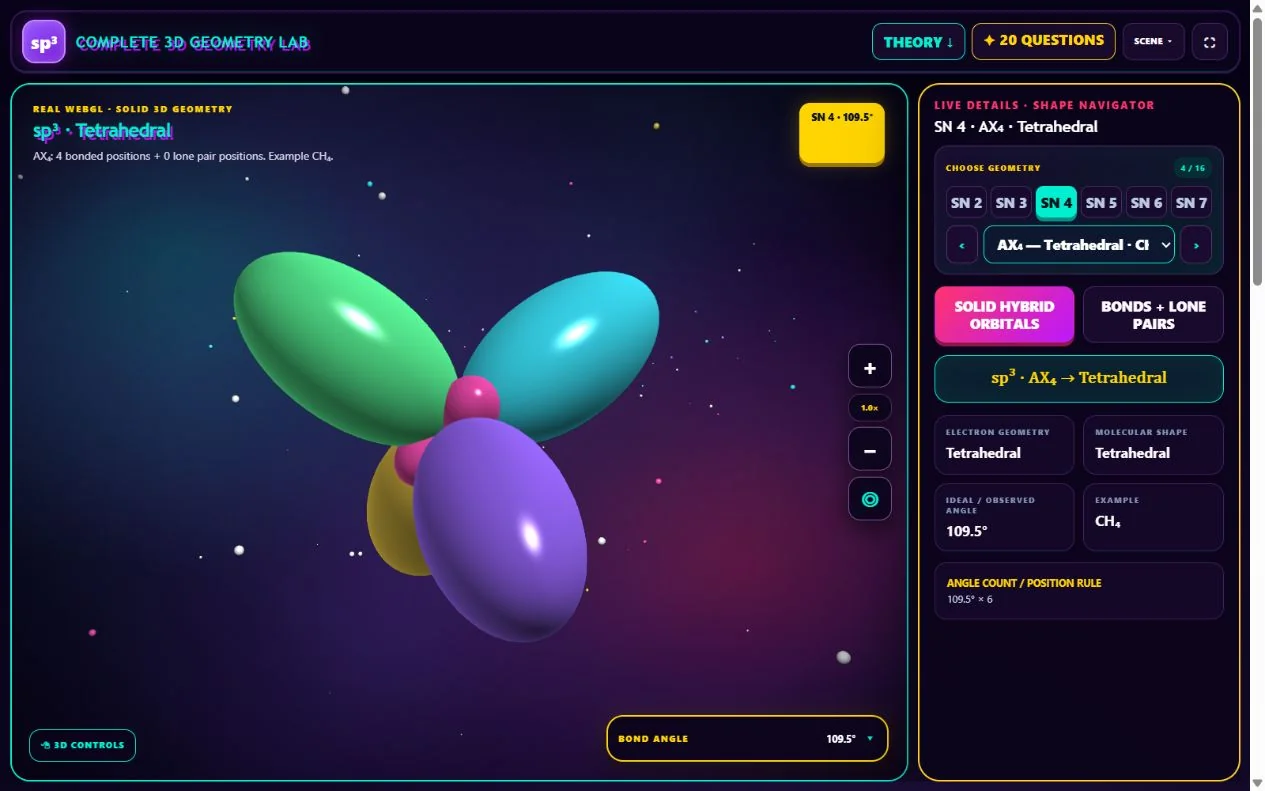
Explore solid hybrid orbitals and complete VSEPR geometries from steric number 2 to 7, then practise 50 foundation, core and advanced questions.
Open related lab →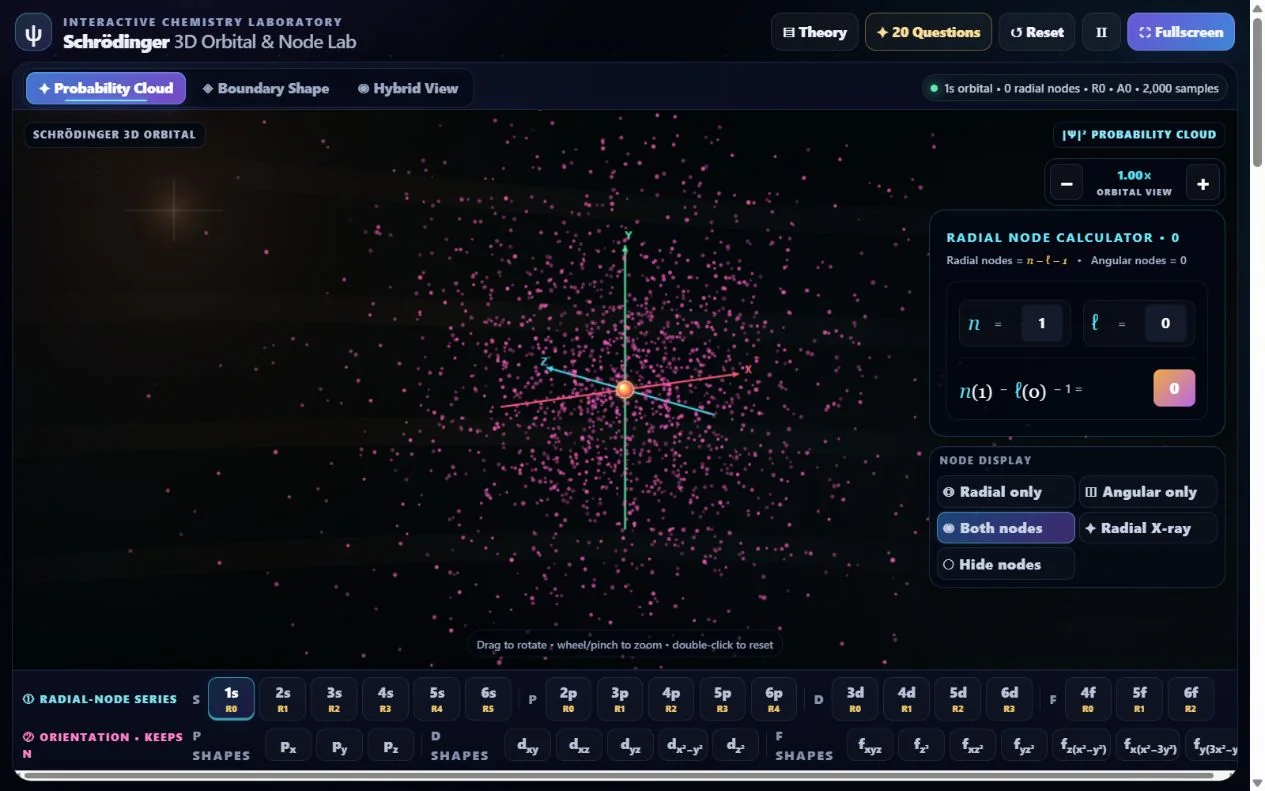 Atomic Structure
Explore probability clouds, boundary shapes and radial/angular nodes across s, p, d and f orbitals in a rotatable 3D space.
Open related lab →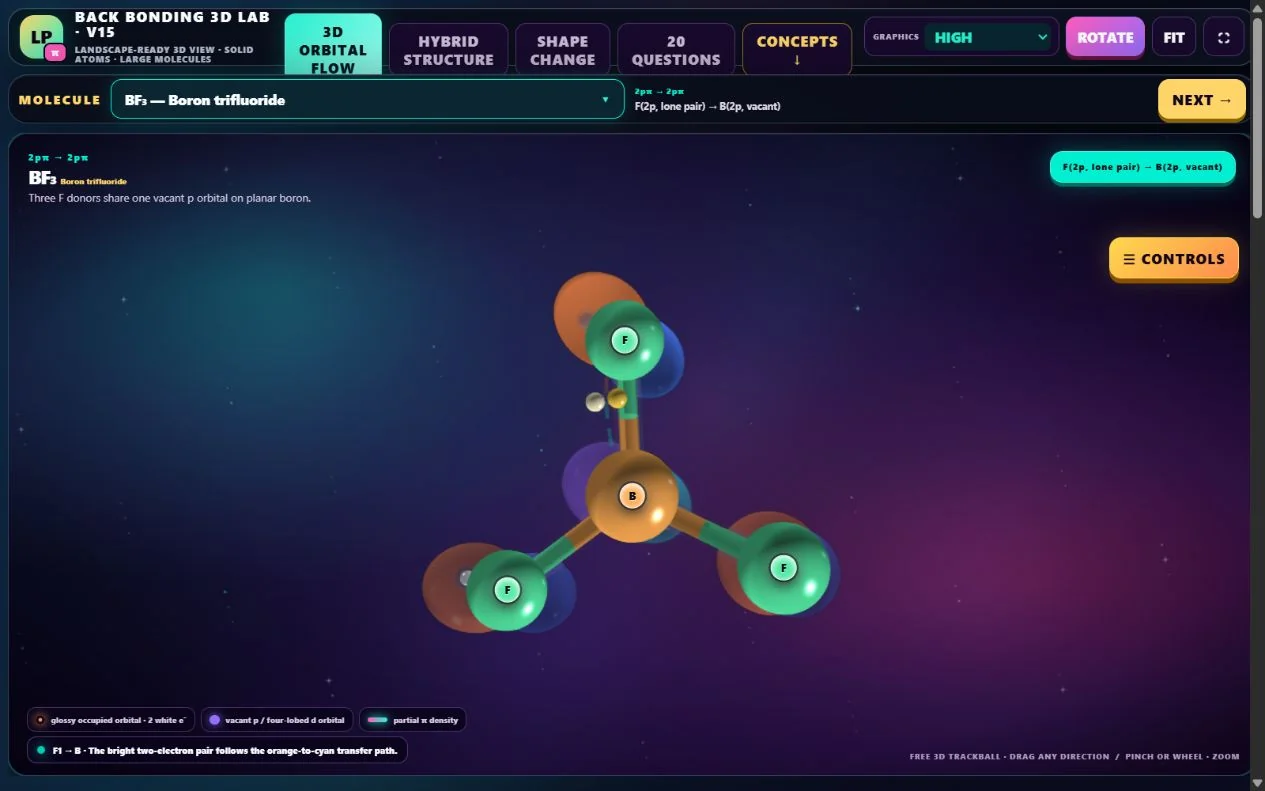 Chemical Bonding
Watch lone-pair donation into a neighbouring vacant orbital, compare 11 back-bonding systems, follow seven shape changes and solve 22 guided challenges.
Open related lab →Connect this lab with related chemistry topics and choose the depth that fits your current studies.
STUDENT DISCUSSION
Loading discussion…
Comments stay outside the simulation. When you exit the lab, you can choose to share a question or observation.