
Why a label can exceed 100%
Free SO₃ reacts with added water: SO₃ + H₂O → H₂SO₄. The product gains mass from that water, so 100 g of oleum can yield more than 100 g of sulfuric acid. The label is not an ordinary component mass percentage.
Opening your lab guide…
The simulation has closed. Your guide is on its way.
LIVE LAB 15 • MOLE CONCEPT & STOICHIOMETRY
Build the mass balance of oleum in a rotatable 3D laboratory, vary the percentage label from 100 to 122.5, run virtual hydration and practise worked Mole Concept questions.
Open paid simulation →Purchase this simulation or get all paid labs with a subscription. View prices →
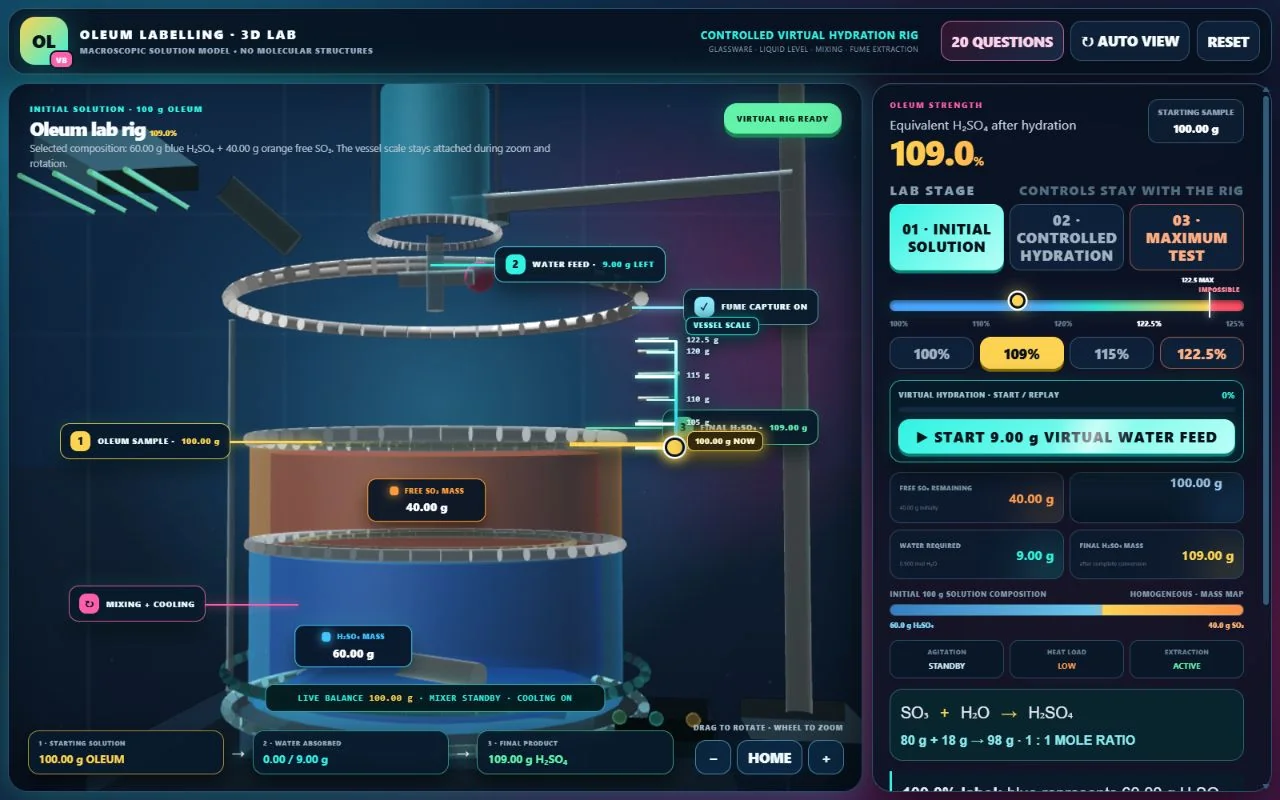 ACTUAL LAB PREVIEW
QUICK START
COMPLETE CONCEPT GUIDE
Oleum is commonly represented in introductory calculations as sulfur trioxide dissolved in sulfuric acid. Its percentage label expresses the mass of sulfuric acid obtainable after adding sufficient water to 100 g of the original oleum.
Free SO₃ reacts with added water: SO₃ + H₂O → H₂SO₄. The product gains mass from that water, so 100 g of oleum can yield more than 100 g of sulfuric acid. The label is not an ordinary component mass percentage.
Using rounded molar masses, 80 g SO₃ consumes 18 g water and forms 98 g H₂SO₄. If 100 g oleum contains x g free SO₃, the equivalent sulfuric acid mass is 100 − x + 98x/80 = 100 + 0.225x grams.
A 109% label means 109 g equivalent H₂SO₄ per 100 g original sample. Thus x = (109 − 100)/0.225 = 40 g free SO₃. In this two-component mass-balance model, the sample contains 60 g H₂SO₄ and requires 9 g added water for complete conversion.
OLEUM LABELLING FAQ
No. The label describes equivalent sulfuric acid after hydration relative to the initial sample mass. In the simplified SO₃/H₂SO₄ model it corresponds to 40% free SO₃ by mass.
With rounded molar masses, 100 g SO₃ can form 122.5 g H₂SO₄ after consuming 22.5 g water. This is the limiting equivalent-acid value for the lab’s two-component calculation model.
RELATED SIMULATIONS
 Electrochemistry
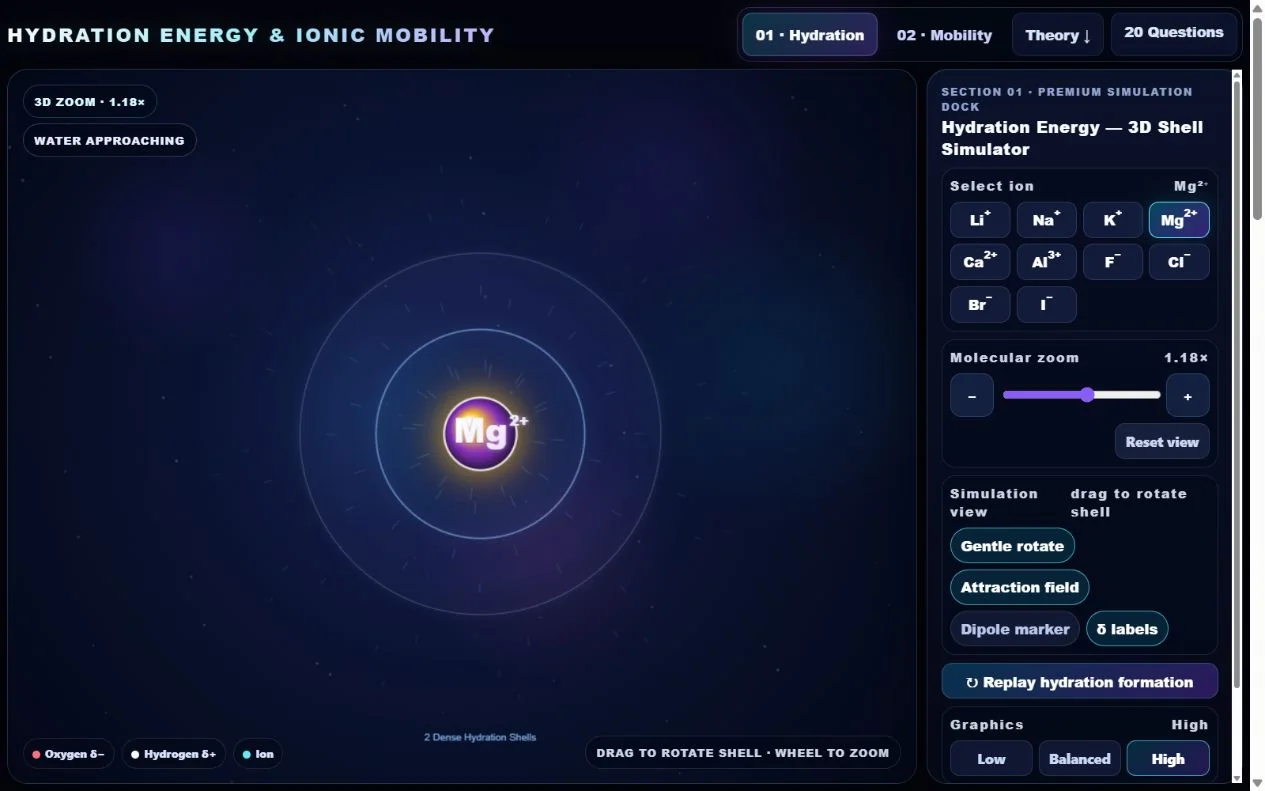
Watch water dipoles approach, orient and lock around an ion in a rotatable 3D hydration shell, then compare realistic hydrated-ion motion in an electric field.
Open related lab →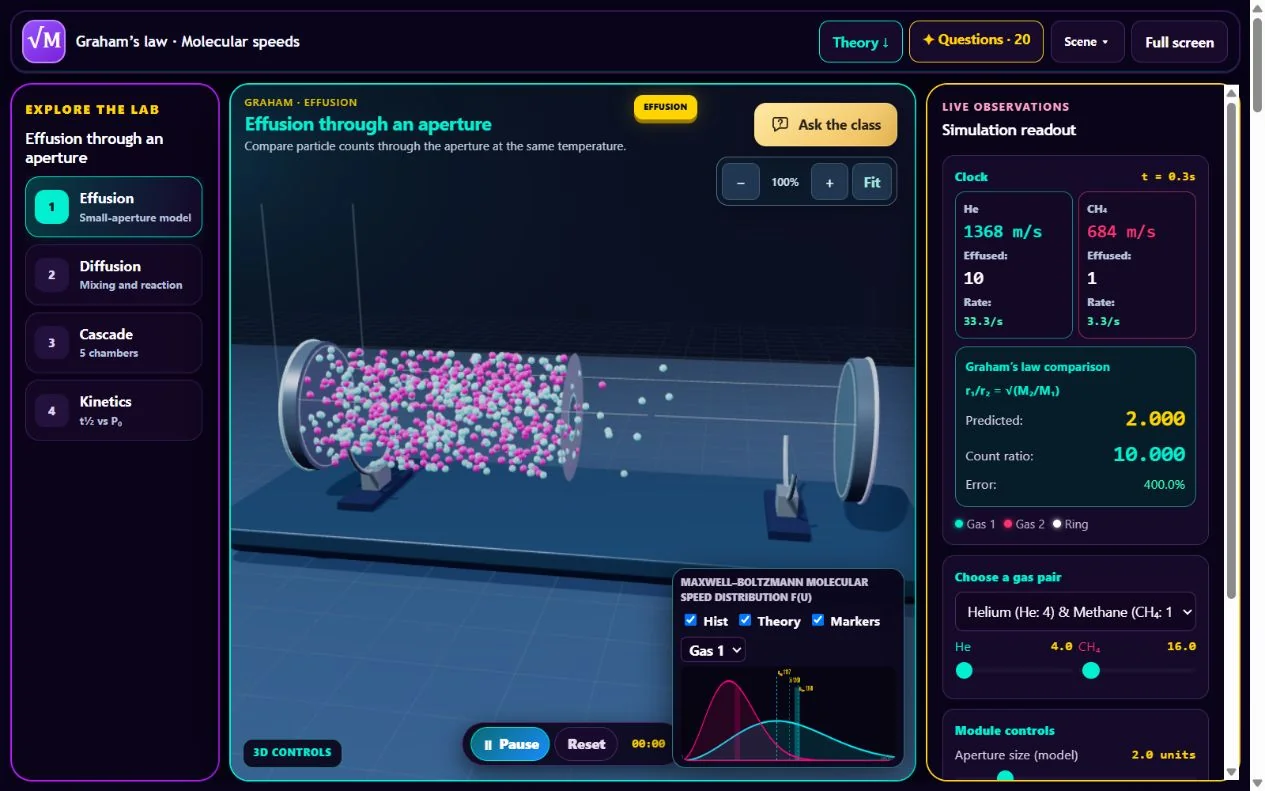 States of Matter & Kinetic Theory
Compare effusion, diffusion and molecular-speed distributions in an interactive gas lab, then connect rate ratios with molar mass and temperature.
Open related lab →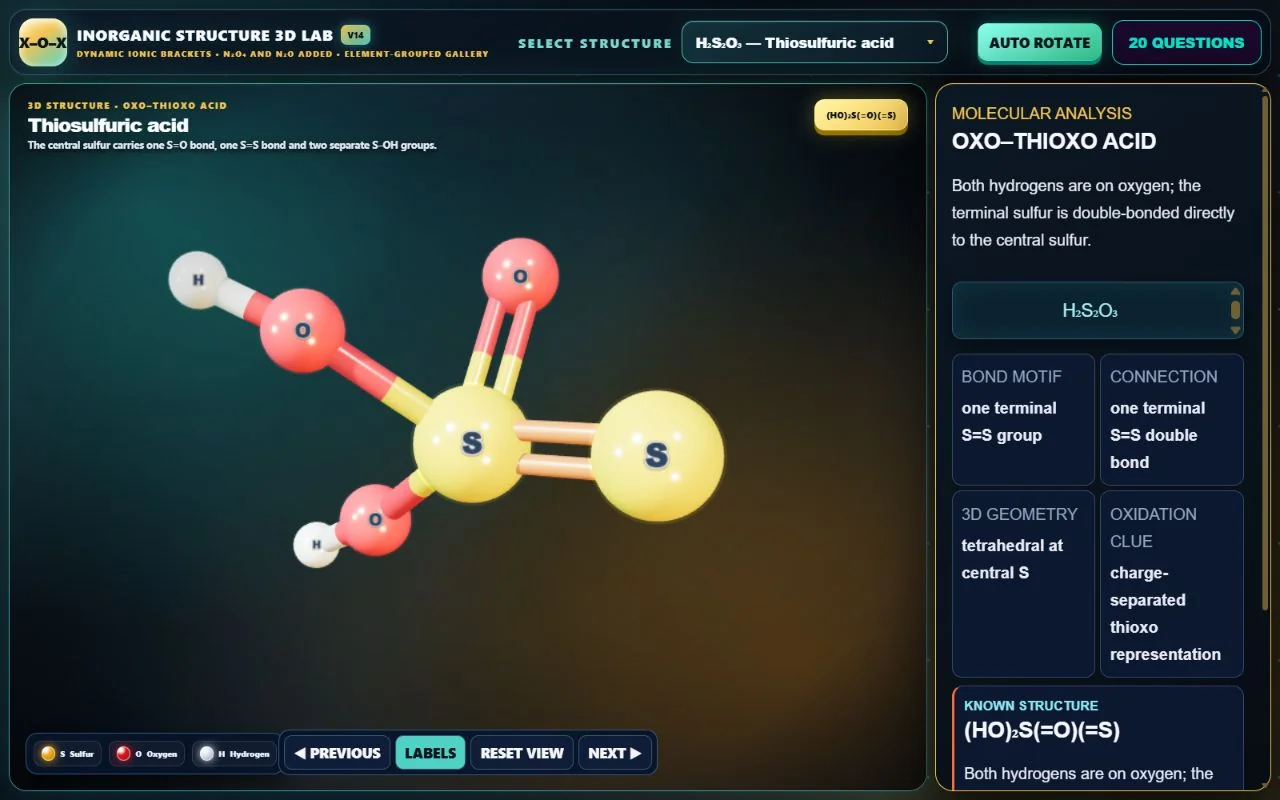 Chemical Bonding
Explore 49 rotatable inorganic structures organised by central element, including oxides, oxyacids, rings, peroxo species, ionic units and network solids.
Open related lab →Connect this lab with related chemistry topics and choose the depth that fits your current studies.
STUDENT DISCUSSION
Loading discussion…
Comments stay outside the simulation. When you exit the lab, you can choose to share a question or observation.