
Stationary and mobile phases
The stationary phase remains fixed while the mobile phase carries the analyte mixture. Different attractions to these phases produce different migration rates and therefore separation.
Opening your lab guide…
The simulation has closed. Your guide is on its way.
LIVE LAB 17 • PURIFICATION & CHARACTERISATION
Run column, thin-layer and paper chromatography in 3D, compare stationary and mobile phases, and measure separation with an interactive Rf calculation.
Open paid simulation →Purchase this simulation or get all paid labs with a subscription. View prices →
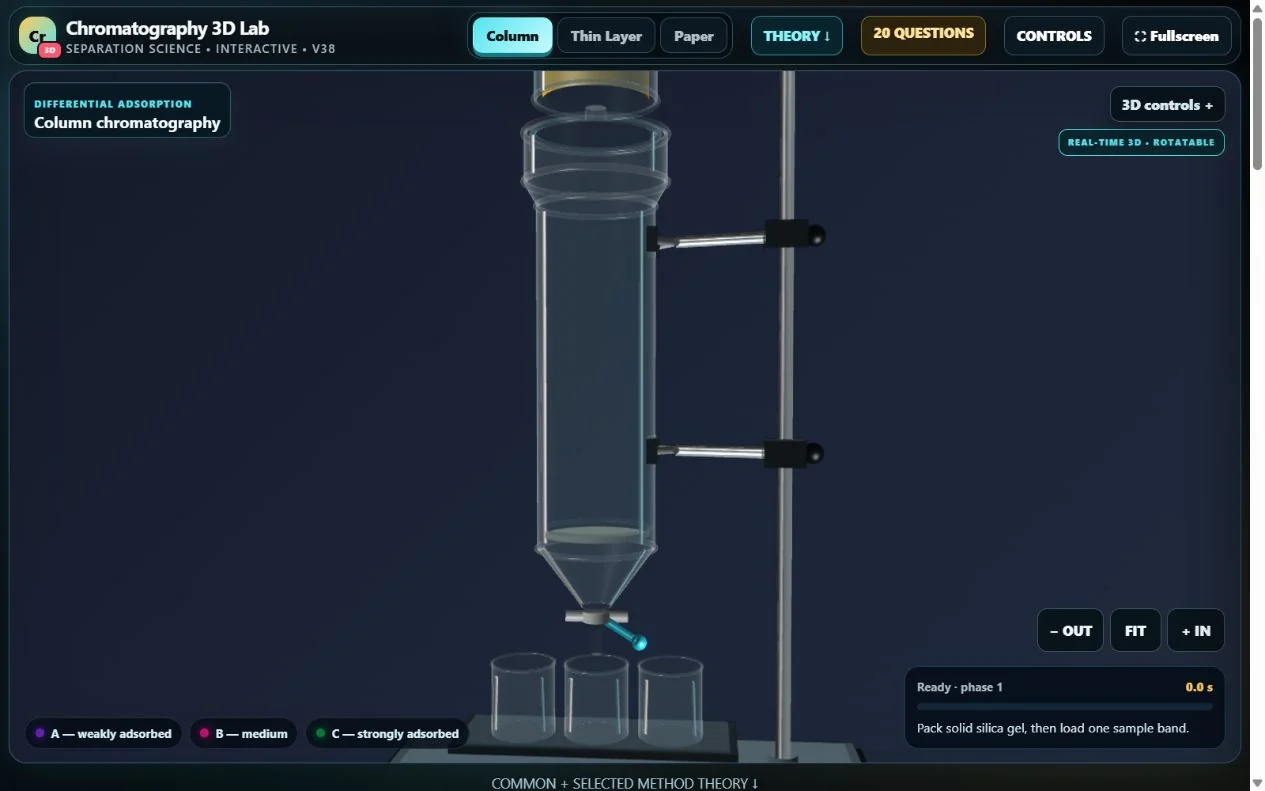 ACTUAL LAB PREVIEW
QUICK START
COMPLETE CONCEPT GUIDE
Learn why mixture components travel at different rates by comparing their attraction to the stationary phase with their preference for the mobile phase. The interactive laboratory connects column separation, thin-layer development, paper partition and Rf measurement in one visual workflow.
The stationary phase remains fixed while the mobile phase carries the analyte mixture. Different attractions to these phases produce different migration rates and therefore separation.
Column chromatography and TLC are commonly described through adsorption on silica or alumina. Paper chromatography is mainly a partition process involving water held in cellulose and a moving solvent.
A solvent carries the mixture through a packed adsorbent. Components that interact less strongly with the stationary phase move faster and leave the column in earlier fractions.
A spotted sample develops on a silica-coated plate as solvent rises by capillary action. The separated spots reveal different affinities and can be compared using Rf values.
Solutes repeatedly distribute between stationary water held by cellulose fibres and the moving solvent. Components with greater mobile-phase preference travel farther.
Rf equals the distance travelled by a component divided by the distance travelled by the solvent front, measured from the same baseline. It is unitless and depends on the experimental conditions.
In normal-phase chromatography, polar compounds usually interact more strongly with the polar stationary phase. A stronger mobile phase competes more effectively for those interactions and can increase component movement.
Useful separation requires components to travel at measurably different rates. Retention describes how strongly a component is delayed, while selectivity compares the relative retention of two components.
CHROMATOGRAPHY FAQ
RELATED SIMULATIONS
 General Organic Chemistry
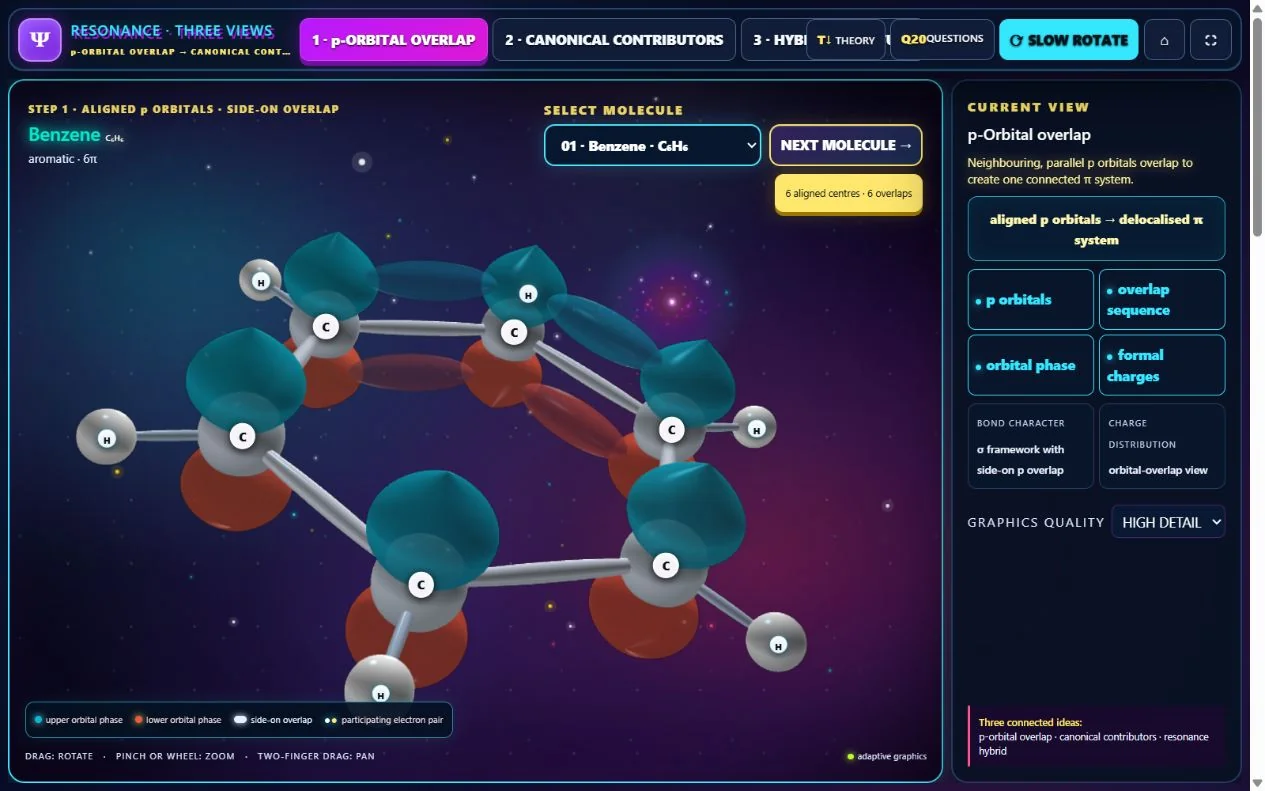
Connect aligned p-orbital overlap with imaginary canonical contributors and the real resonance hybrid across 23 important conjugated systems.
Open related lab →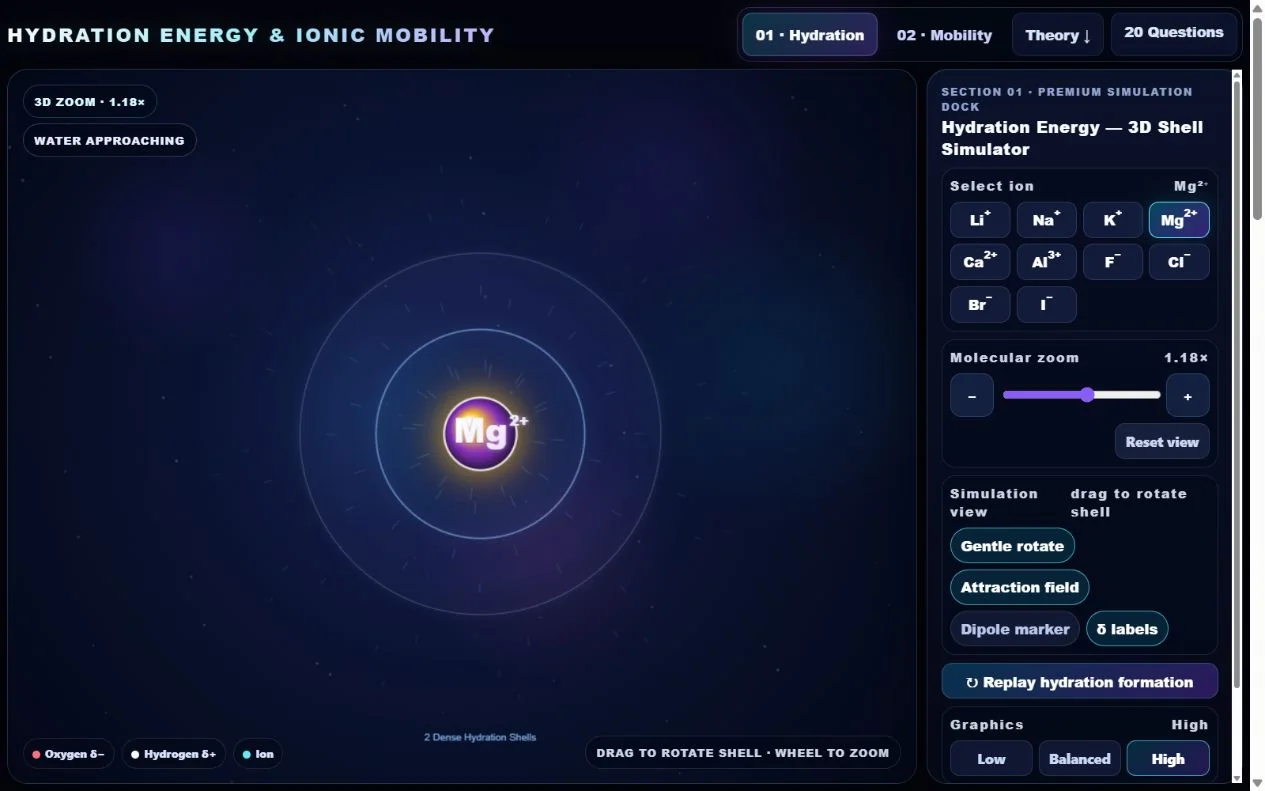 Electrochemistry
Watch water dipoles approach, orient and lock around an ion in a rotatable 3D hydration shell, then compare realistic hydrated-ion motion in an electric field.
Open related lab →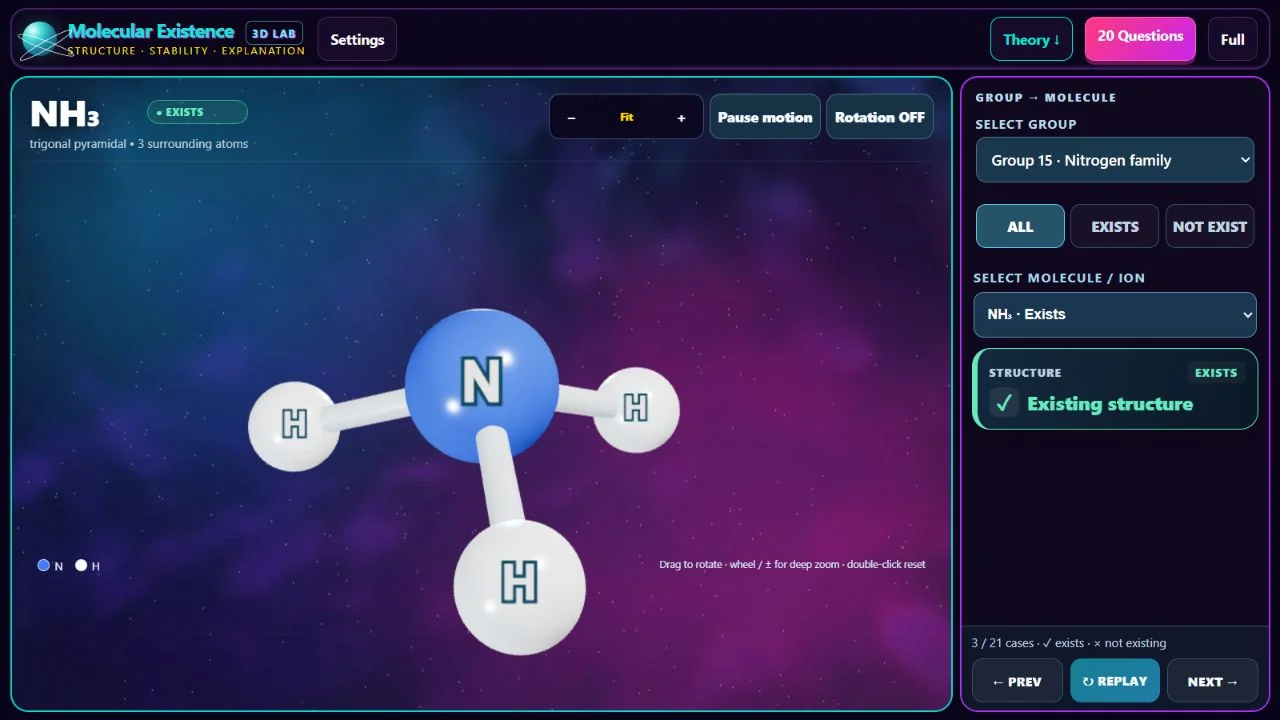 Chemical Bonding
Explore 106 molecule and ion cases by periodic group, then compare their structures, stability, ligand effects and redox behaviour.
Open related lab →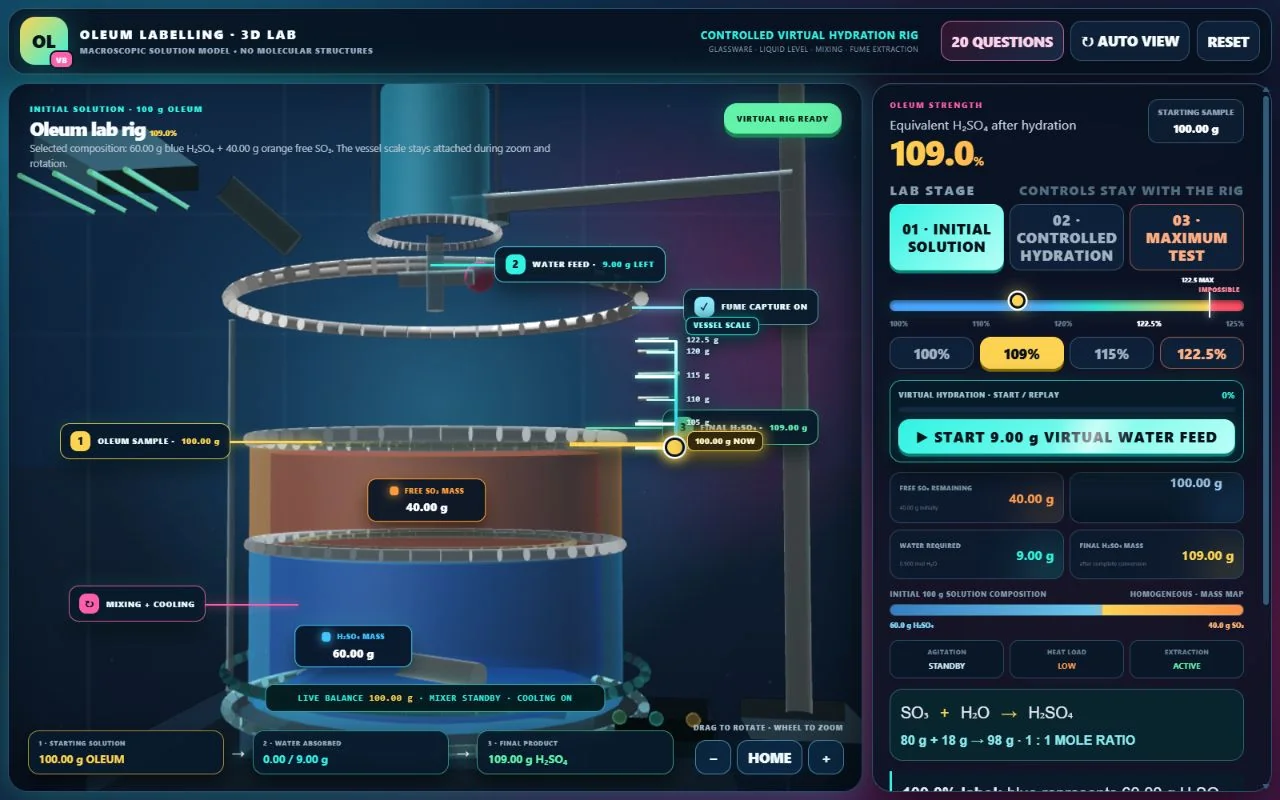 Mole Concept & Stoichiometry
Build the mass balance of oleum in a rotatable 3D laboratory, vary the percentage label from 100 to 122.5, run virtual hydration and practise worked Mole Concept questions.
Open related lab →Connect this lab with related chemistry topics and choose the depth that fits your current studies.
STUDENT DISCUSSION
Loading discussion…
Chromatography separates components because they interact differently with a stationary phase and a mobile phase. Stronger stationary-phase attraction slows movement, while stronger mobile-phase preference increases movement.
Adsorption chromatography separates substances through different attraction to a solid surface. Partition chromatography separates them through different distribution between two phases, commonly two liquids.
Rf is the distance travelled by the centre of a component spot divided by the distance travelled by the solvent front, with both distances measured from the same baseline.
If the sample spot is submerged, it can dissolve directly into the solvent reservoir instead of moving upward with the solvent front, which spoils the separation.
They have different balances of attraction to the packed stationary phase and solubility in the moving eluent. Weakly retained components travel through the column more quickly.
No. Rf changes with the stationary phase, solvent composition, temperature, sample loading and other experimental conditions, so comparisons require matched conditions.
On a polar silica plate, more polar compounds usually interact more strongly with the stationary phase and travel less, while less polar compounds generally move farther with the solvent.
A stronger mobile phase competes more effectively with analytes for the stationary phase, so spots commonly travel farther and their Rf values increase. Excessive solvent strength can reduce separation by moving all spots near the solvent front.
The eluent is the mobile-phase solvent introduced into a chromatography column. The eluate is the liquid leaving the column after passing through the stationary phase.
The solvent begins evaporating after the plate or paper is removed from the chamber. Marking the front immediately preserves the correct travel distance needed for an accurate Rf calculation.
Comments stay outside the simulation. When you exit the lab, you can choose to share a question or observation.