
Where s character concentrates
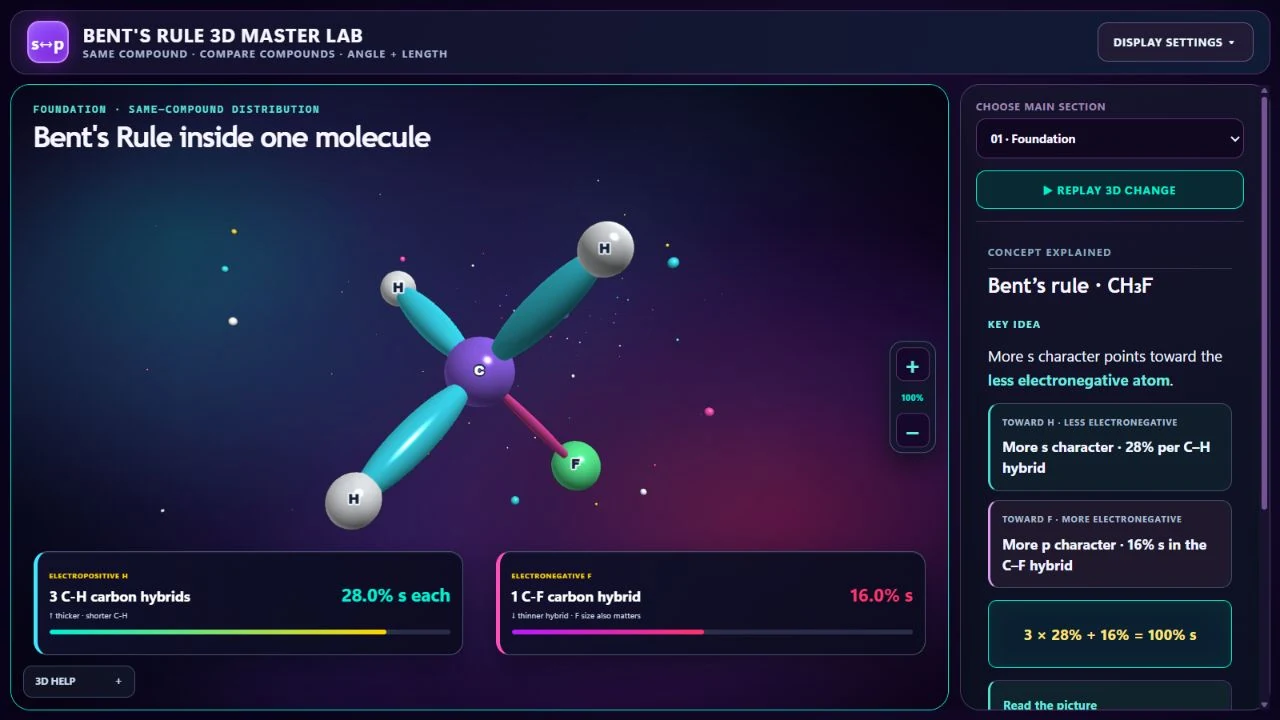
Bent’s rule states that central-atom s character tends to concentrate in bonds toward more electropositive substituents. Bonds toward more electronegative substituents tend to receive more p character.
Opening your lab guide…
The simulation has closed. Your guide is on its way.
LIVE LAB 10 • CHEMICAL BONDING
See how central-atom s and p character redistribute between bonds, then connect hybrid character with angles, placement and bond length.
Open paid simulation →Purchase this simulation or get all paid labs with a subscription. View prices →
 ACTUAL LAB PREVIEW
QUICK START
COMPLETE CONCEPT GUIDE
Hybrid orbitals on a central atom need not have identical compositions. Bent’s rule helps explain how their s and p character changes when the surrounding substituents have different electronegativities.
Bent’s rule states that central-atom s character tends to concentrate in bonds toward more electropositive substituents. Bonds toward more electronegative substituents tend to receive more p character.
Ideal sp, sp² and sp³ pictures are useful starting points. In a molecule with unlike substituents, redistribution of hybrid character can contribute to deviations from ideal angles. Lone pairs, steric effects and the bonding environment also matter.
Greater s character often gives a shorter, stronger bond when comparing otherwise similar bonds. Do not compare unrelated bonds using s character alone: atom size, bond order and polarity also affect the observed length.
BENT'S RULE FAQ
In Bent’s rule, the central atom directs more p character toward more electronegative substituents and more s character toward more electropositive ones.
No. VSEPR gives a useful geometry framework from electron domains. Bent’s rule adds a qualitative explanation of how hybrid character can be distributed unequally within that framework.
RELATED SIMULATIONS
 Chemical Bonding
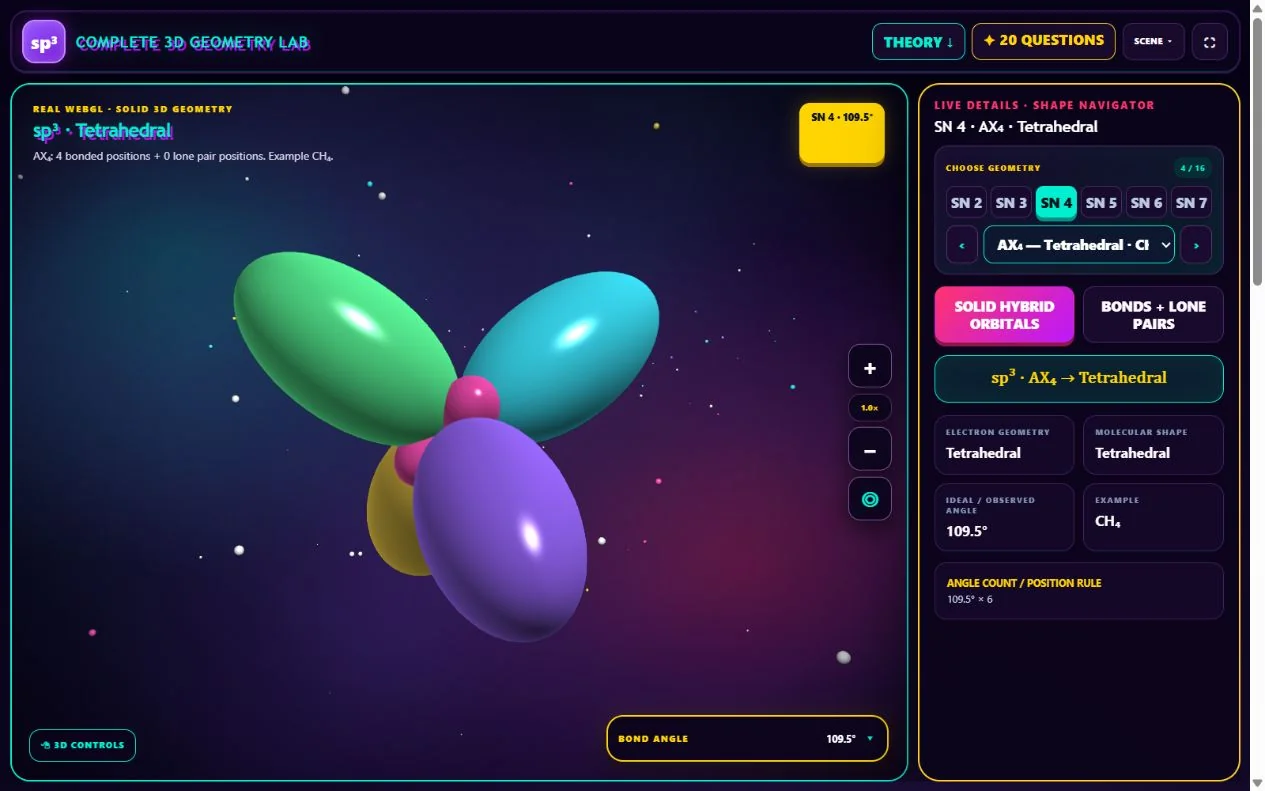
Explore solid hybrid orbitals and complete VSEPR geometries from steric number 2 to 7, then practise 50 foundation, core and advanced questions.
Open related lab →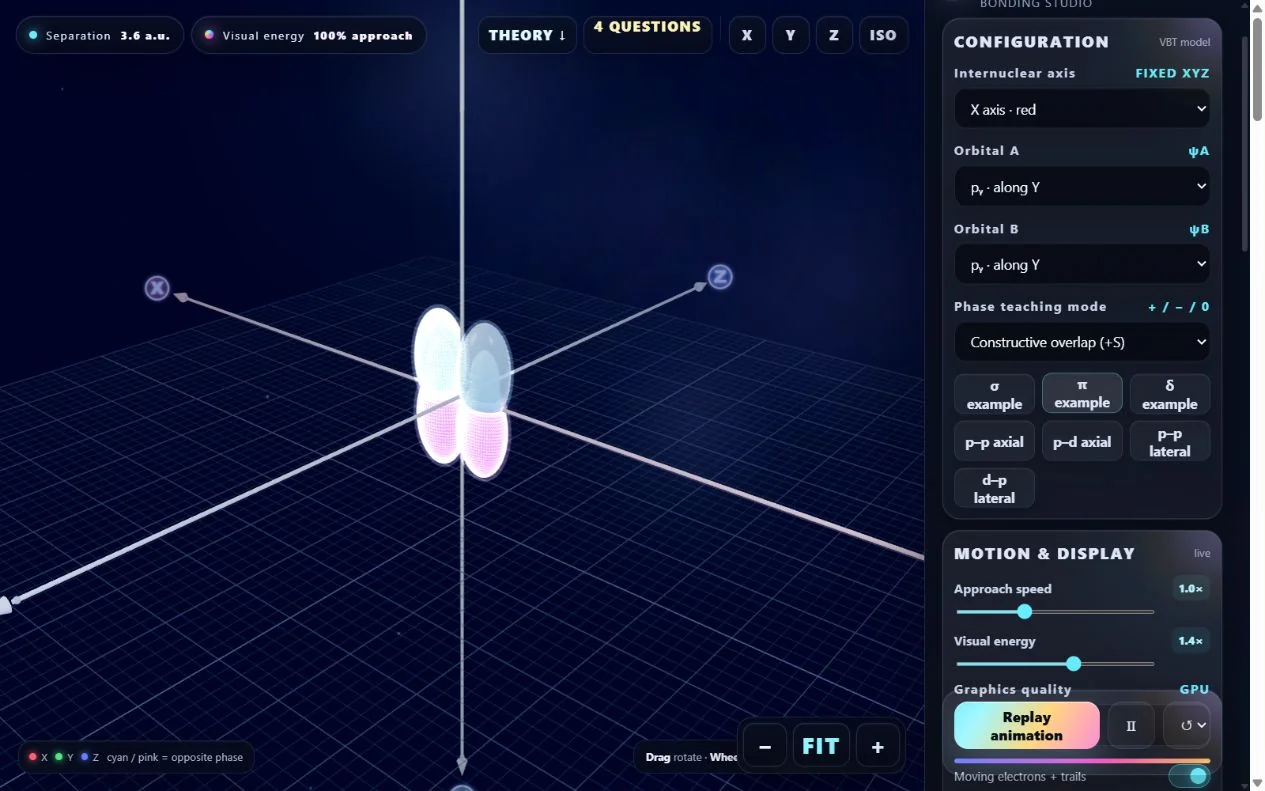 Chemical Bonding
Choose two s, p or d orbitals and an internuclear axis, then test whether their symmetry and phase produce σ, π, δ, mixed or no overlap.
Open related lab →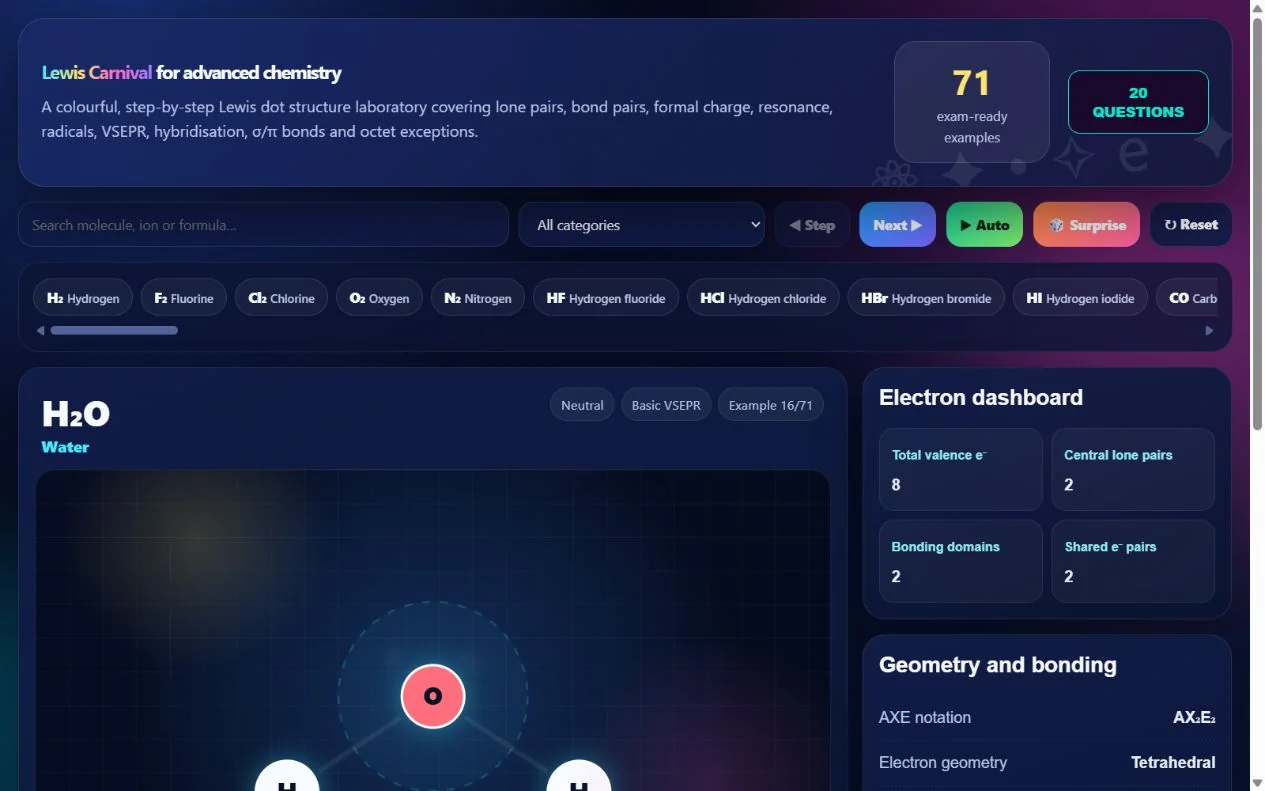 Chemical Bonding
Build Lewis dot structures step by step across molecules and ions while tracking valence electrons, formal charge, resonance, geometry and σ/π bonding.
Open related lab →Connect this lab with related chemistry topics and choose the depth that fits your current studies.
STUDENT DISCUSSION
Loading discussion…
Comments stay outside the simulation. When you exit the lab, you can choose to share a question or observation.