
Counting nodes
For hydrogen-like atomic orbitals, total nodes equal n − 1, angular nodes equal l, and radial nodes equal n − l − 1. The values l = 0, 1, 2 and 3 correspond to s, p, d and f orbitals.
Opening your lab guide…
The simulation has closed. Your guide is on its way.
LIVE LAB 05 • ATOMIC STRUCTURE
Explore probability clouds, boundary shapes and radial/angular nodes across s, p, d and f orbitals in a rotatable 3D space.
Start free simulation →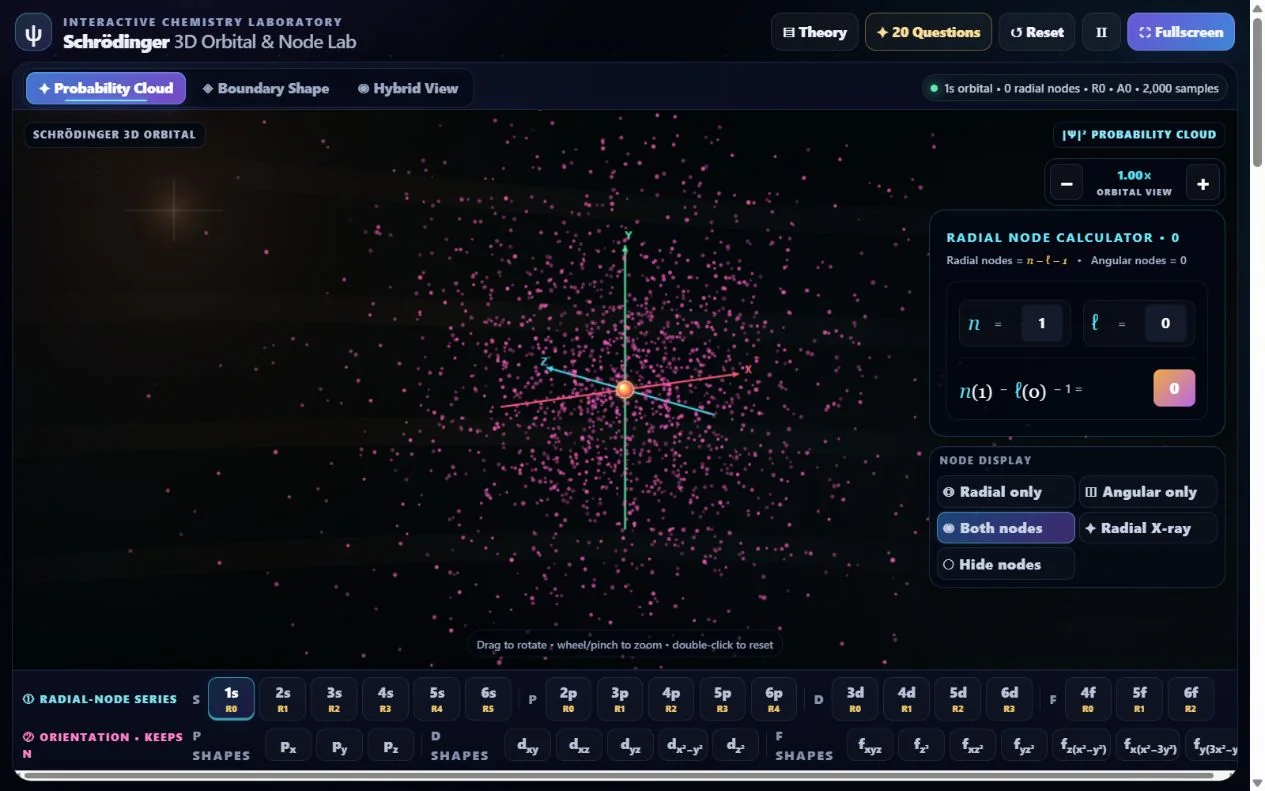 ACTUAL LAB PREVIEW
QUICK START
COMPLETE CONCEPT GUIDE
An orbital describes an electron wavefunction, not a circular path. Rotate the probability cloud and boundary representations to distinguish orbital shape from the regions where the wavefunction is zero.
For hydrogen-like atomic orbitals, total nodes equal n − 1, angular nodes equal l, and radial nodes equal n − l − 1. The values l = 0, 1, 2 and 3 correspond to s, p, d and f orbitals.
A 2p orbital has one angular node and no radial node. A 3p orbital has one angular and one radial node. A 3d orbital has two angular nodes and no radial node. Changing n and l changes different features of the orbital.
The squared magnitude of the wavefunction gives probability density. A boundary surface encloses a chosen fraction of the probability; it is not a physical wall. Angular nodes may be planes or cones, depending on the orbital.
ORBITAL & NODE LAB FAQ
For 3s, n = 3 and l = 0. The radial-node count is 3 − 0 − 1 = 2, and there are no angular nodes.
No. An orbit is a definite trajectory. An orbital is a wavefunction used to describe the probability distribution and other properties of an electron.
RELATED SIMULATIONS
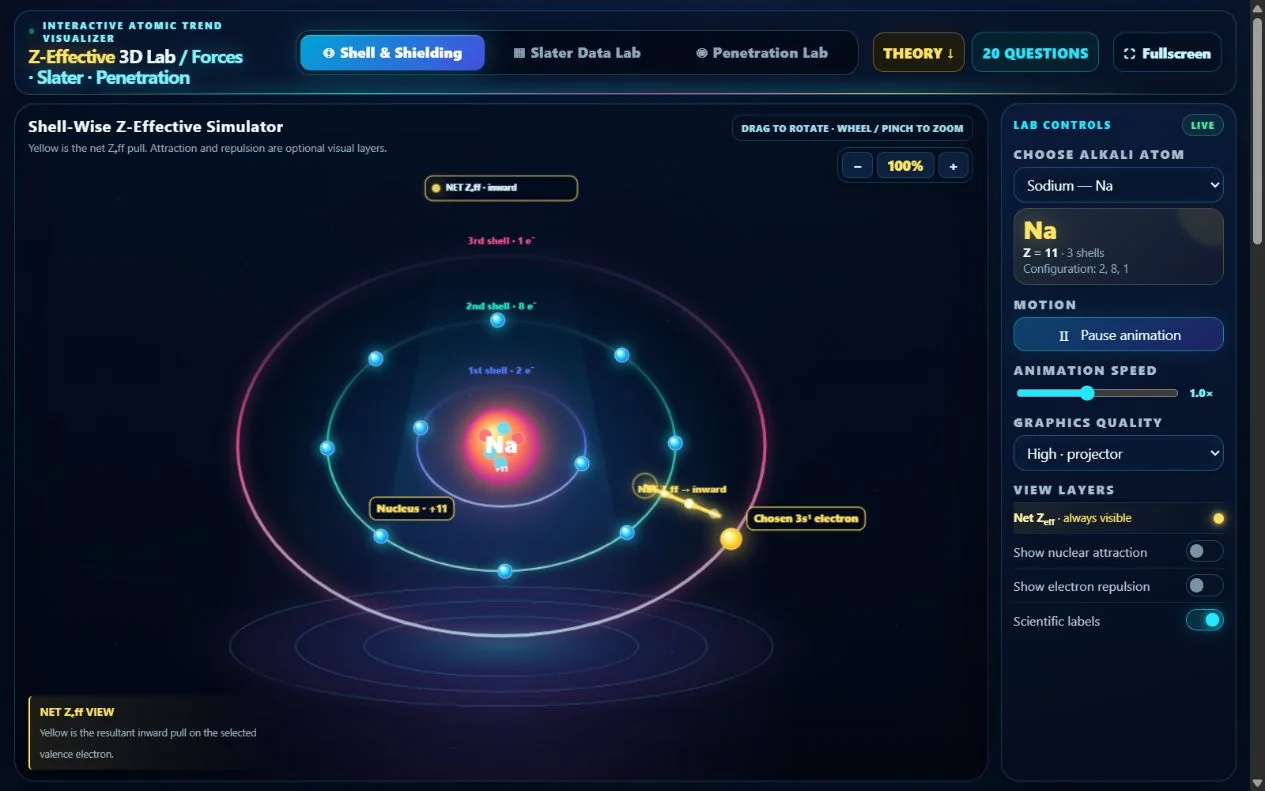 Atomic Structure
Visualise effective nuclear charge as nuclear attraction minus shielding, apply Slater's rules across Period 2 and Group 1, and compare s, p, d and f penetration.
Open related lab →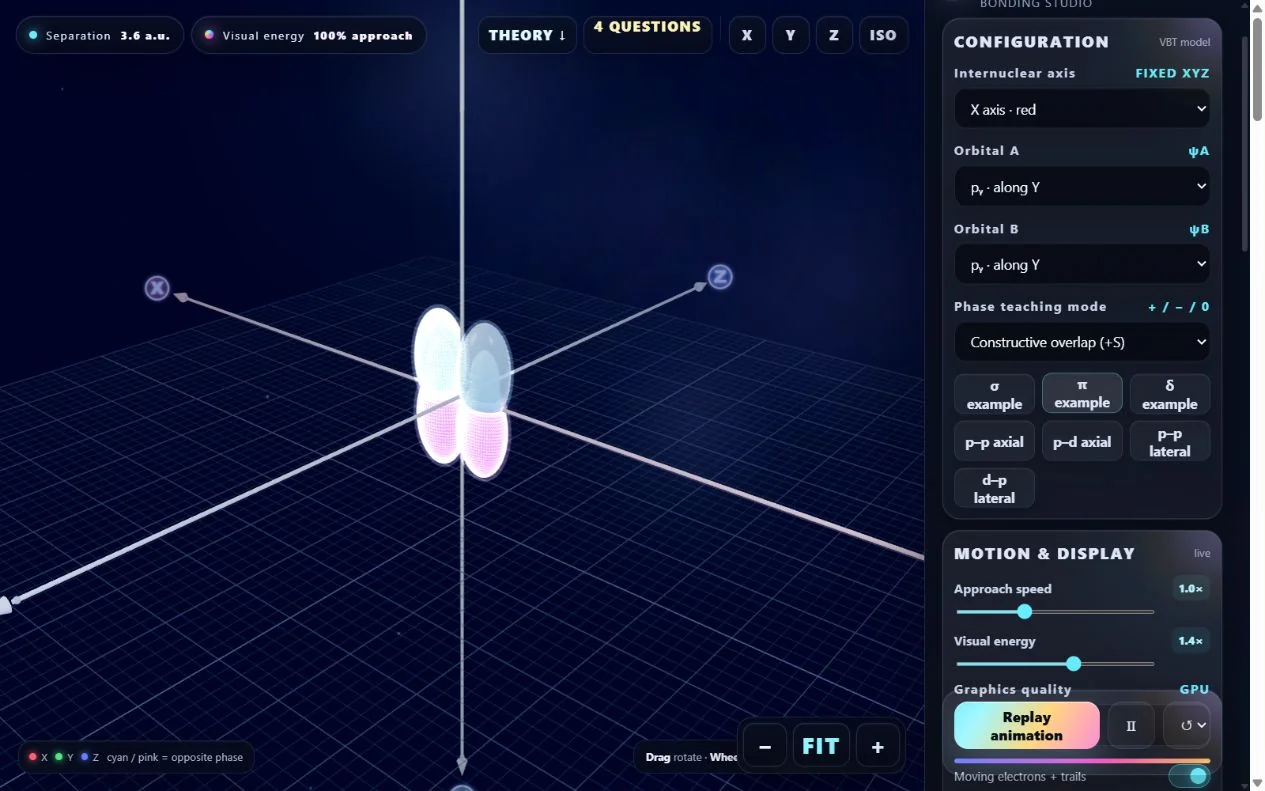 Chemical Bonding
Choose two s, p or d orbitals and an internuclear axis, then test whether their symmetry and phase produce σ, π, δ, mixed or no overlap.
Open related lab →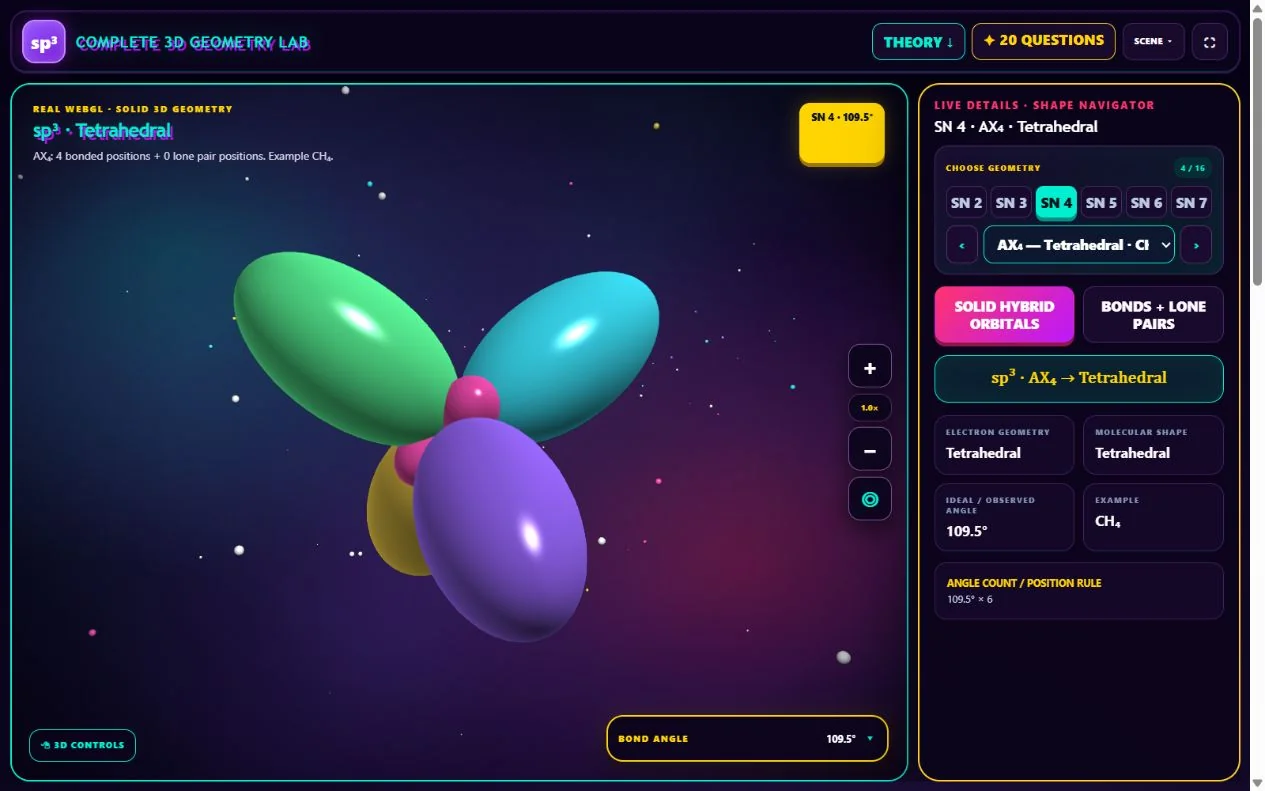 Chemical Bonding
Explore solid hybrid orbitals and complete VSEPR geometries from steric number 2 to 7, then practise 50 foundation, core and advanced questions.
Open related lab →Connect this lab with related chemistry topics and choose the depth that fits your current studies.
STUDENT DISCUSSION
Loading discussion…
Comments stay outside the simulation. When you exit the lab, you can choose to share a question or observation.