
Ideal-gas state
Pressure, volume, temperature and amount are linked by PV = nRT. A change in one variable requires another part of the state to respond unless an external constraint holds it fixed.
Opening your lab guide…
The simulation has closed. Your guide is on its way.
LIVE LAB 19 • STATES OF MATTER & GAS LAWS
Explore pressure, volume, temperature and amount in a live piston model, trace gas-law curves, collect data and connect macroscopic changes with particle motion.
Open paid simulation →Purchase this simulation or get all paid labs with a subscription. View prices →
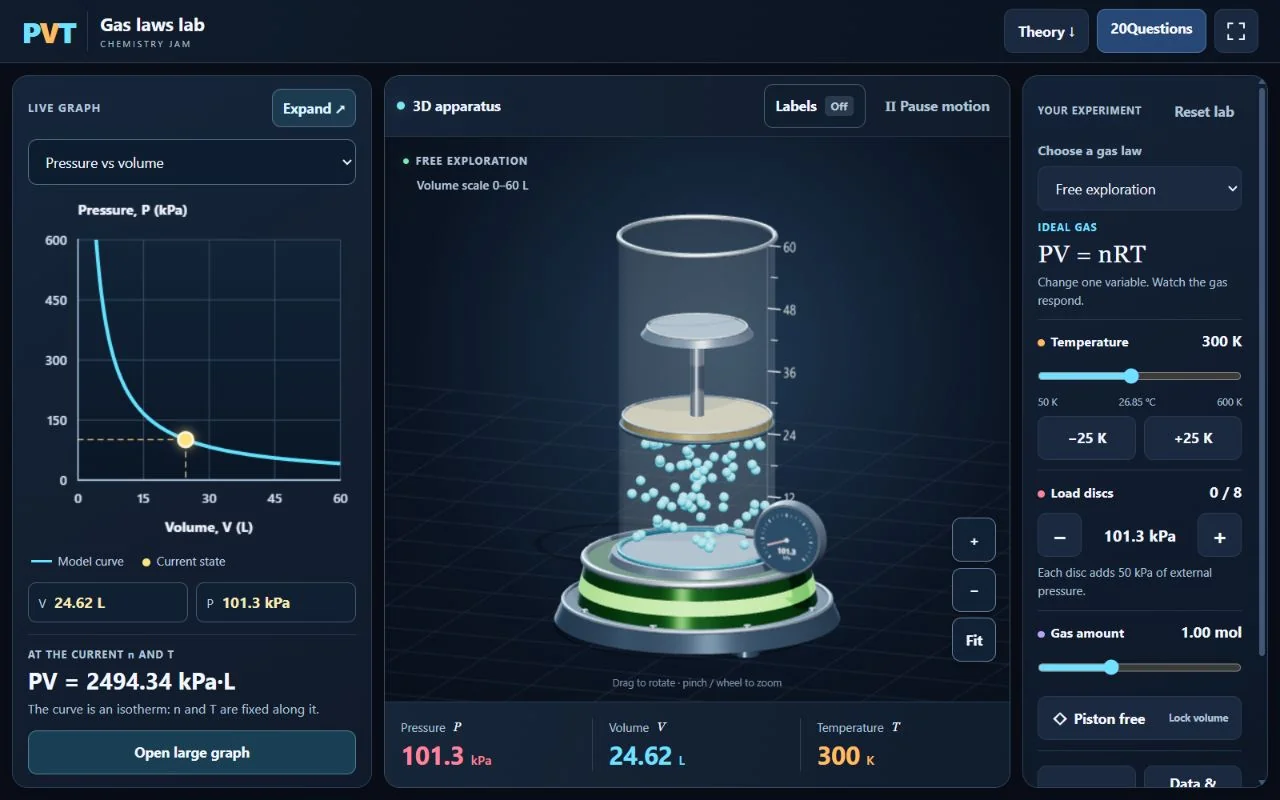 ACTUAL LAB PREVIEW
QUICK START
COMPLETE CONCEPT GUIDE
Use a live piston-and-particle model to connect the ideal-gas equation with Boyle’s law, Charles’s law and the pressure law. Change one variable, hold the required conditions fixed and read the corresponding curve.
Pressure, volume, temperature and amount are linked by PV = nRT. A change in one variable requires another part of the state to respond unless an external constraint holds it fixed.
At fixed temperature and amount, pressure is inversely proportional to volume. Compressing the gas increases the frequency of particle collisions with the container walls.
At fixed pressure and amount, volume is directly proportional to absolute temperature. A freely moving piston rises as heating increases particle momentum.
At fixed volume and amount, pressure is directly proportional to absolute temperature. Locking the piston keeps volume constant while faster particles raise the pressure.
P–V is a rectangular hyperbola under Boyle conditions, while V–T and P–T become straight lines when temperature is measured in kelvin and the required variables remain fixed.
P–V–T GAS LAWS FAQ
It represents a gas state using pressure, volume and temperature together. For a fixed amount of ideal gas, the variables are constrained by PV = nRT.
Kelvin begins at absolute zero, so it is the appropriate proportional temperature scale. Celsius has an offset and cannot be used directly in gas-law ratios.
Temperature and amount of gas remain constant while pressure and volume change inversely.
Heating raises molecular speeds. Particles strike the walls more often and with greater momentum change, producing greater pressure.
RELATED SIMULATIONS
 States of Matter & Kinetic Theory
Explore molecular motion and speed distributions in 3D. Change temperature and gas mass, compare fixed speed bands and practise 20 questions with worked solutions.
Open related lab →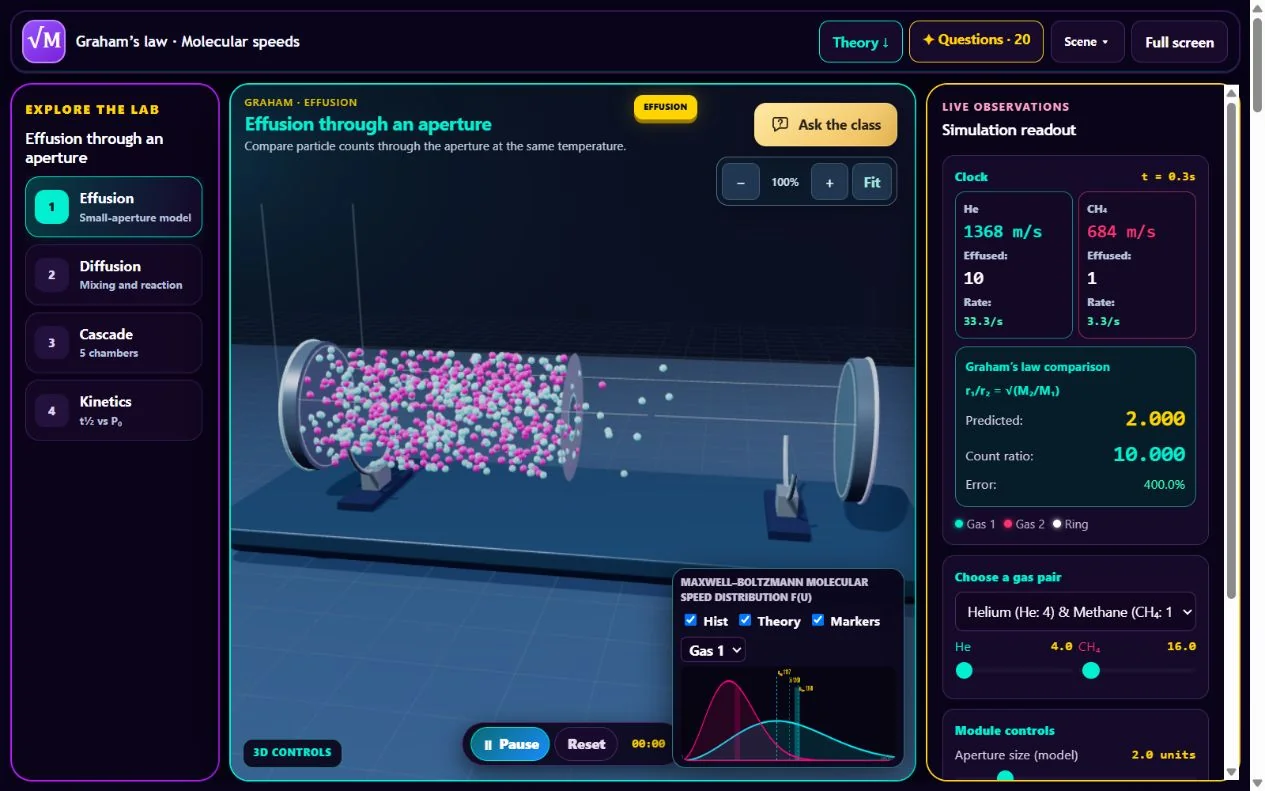 States of Matter & Kinetic Theory
Compare effusion, diffusion and molecular-speed distributions in an interactive gas lab, then connect rate ratios with molar mass and temperature.
Open related lab →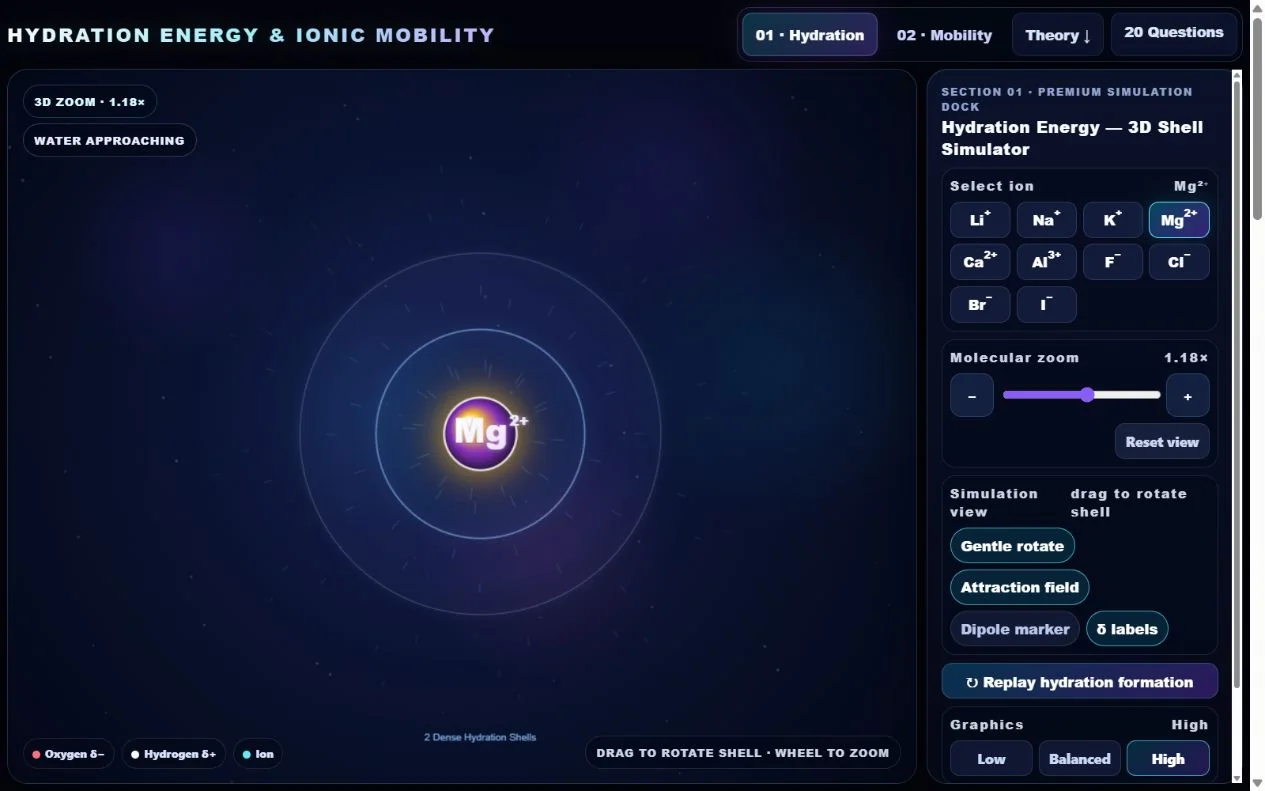 Electrochemistry
Watch water dipoles approach, orient and lock around an ion in a rotatable 3D hydration shell, then compare realistic hydrated-ion motion in an electric field.
Open related lab →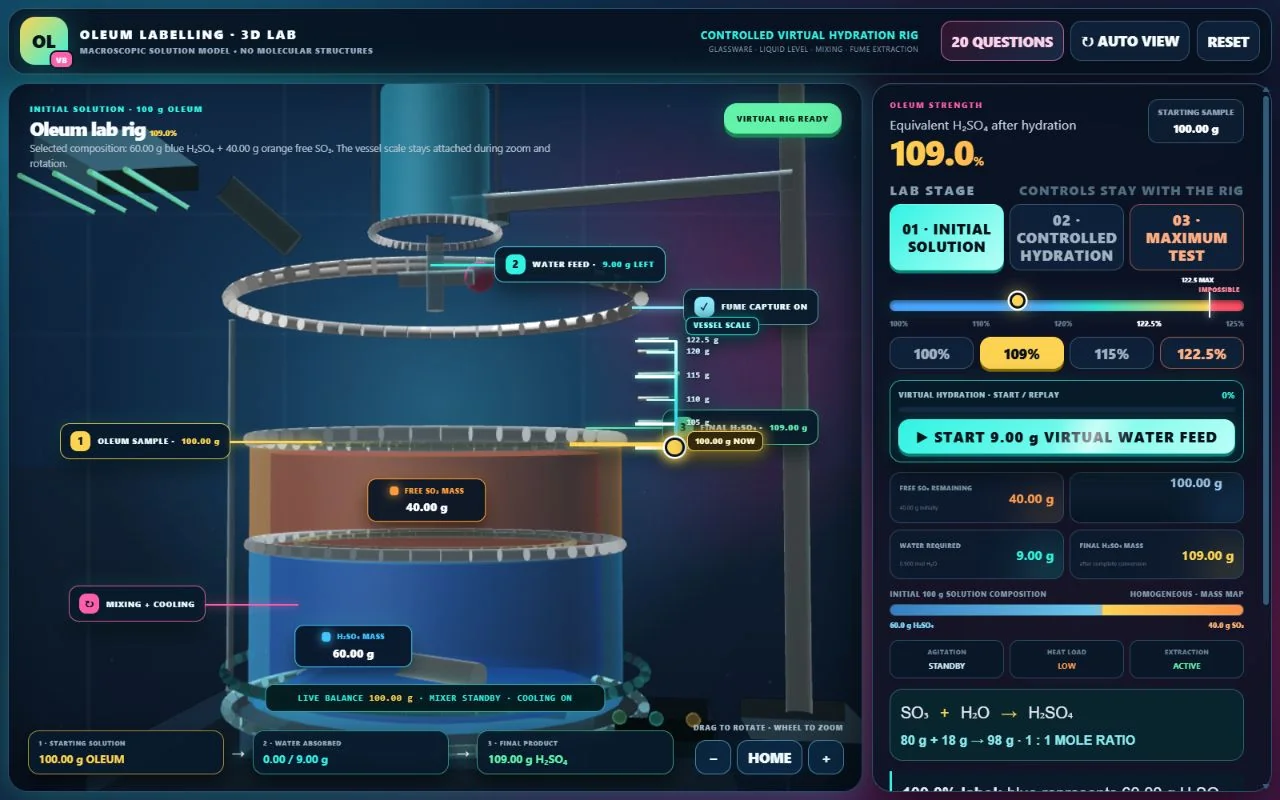 Mole Concept & Stoichiometry
Build the mass balance of oleum in a rotatable 3D laboratory, vary the percentage label from 100 to 122.5, run virtual hydration and practise worked Mole Concept questions.
Open related lab →Connect this lab with related chemistry topics and choose the depth that fits your current studies.
STUDENT DISCUSSION
Loading discussion…
Comments stay outside the simulation. When you exit the lab, you can choose to share a question or observation.