
Polarizing power of a cation
A smaller cation with greater positive charge generally has stronger polarizing power. Hold the anion fixed in the simulation and change the cation’s charge or radius to distinguish these two influences.
Opening your lab guide…
The simulation has closed. Your guide is on its way.
LIVE LAB 04 • CHEMICAL BONDING
Keep ion centres fixed while charge, radius, shielding and electronic configuration reshape the anion cloud, then compare compounds and test Fajan's rule.
Start free simulation →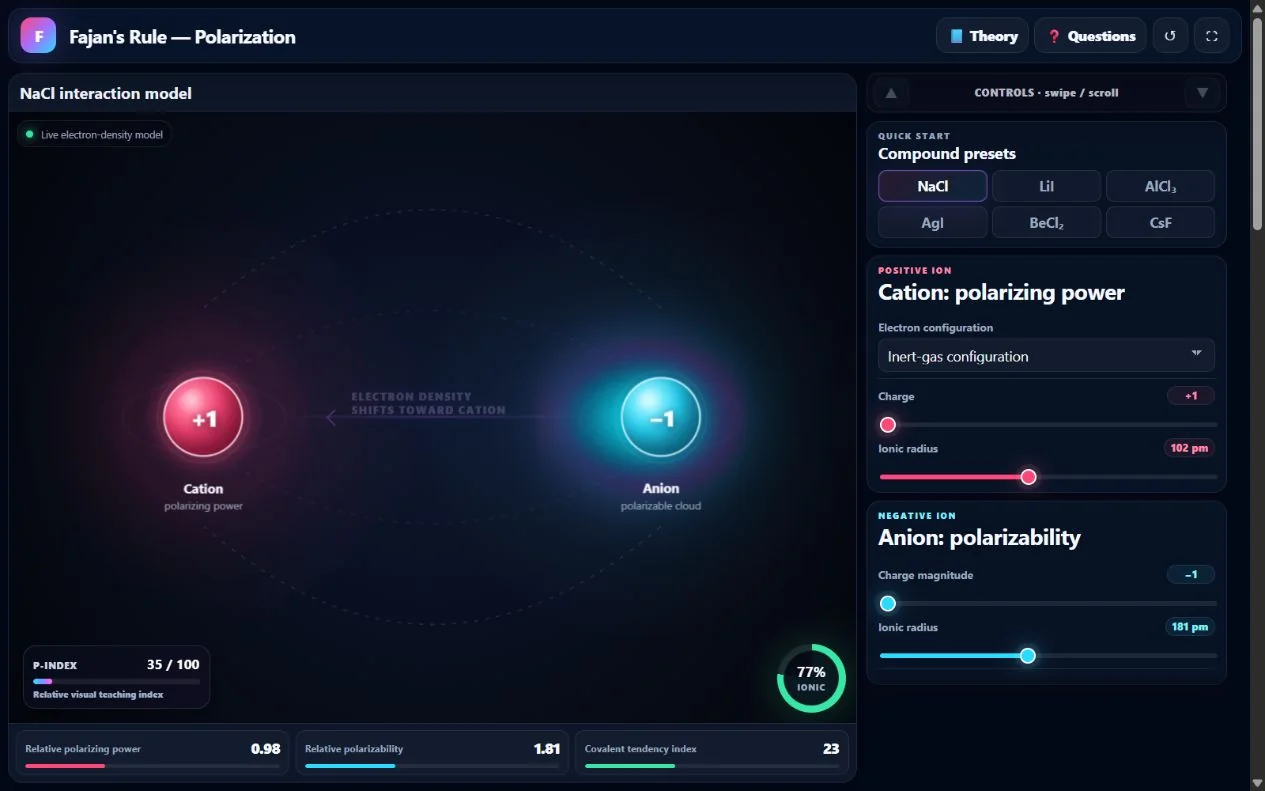 ACTUAL LAB PREVIEW
QUICK START
COMPLETE CONCEPT GUIDE
An ionic model places positive and negative ions next to each other. Fajans’ rules explain how distortion of an anion’s electron cloud by a cation can give the interaction greater covalent character.
A smaller cation with greater positive charge generally has stronger polarizing power. Hold the anion fixed in the simulation and change the cation’s charge or radius to distinguish these two influences.
Larger anions usually have more easily distorted electron clouds. For the same cation, an iodide commonly shows more covalent character than a fluoride. Compare otherwise similar compounds before applying this qualitative trend.
Cations of similar size and charge can still differ in polarizing power because of their electronic configurations and shielding. Fajans’ rules are qualitative comparisons; they do not supply an exact numerical percentage of covalent bonding.
FAJAN'S RULE- POLARIZATION FAQ
Polarizing power is an ion’s ability to distort another ion’s electron cloud. Polarizability is the ease with which that cloud can be distorted. In the usual Fajans’ rules comparison, these refer to the cation and anion respectively.
With the same lithium cation, the larger iodide electron cloud is more easily polarized than the smaller fluoride cloud, giving lithium iodide greater covalent character in this comparison.
RELATED SIMULATIONS
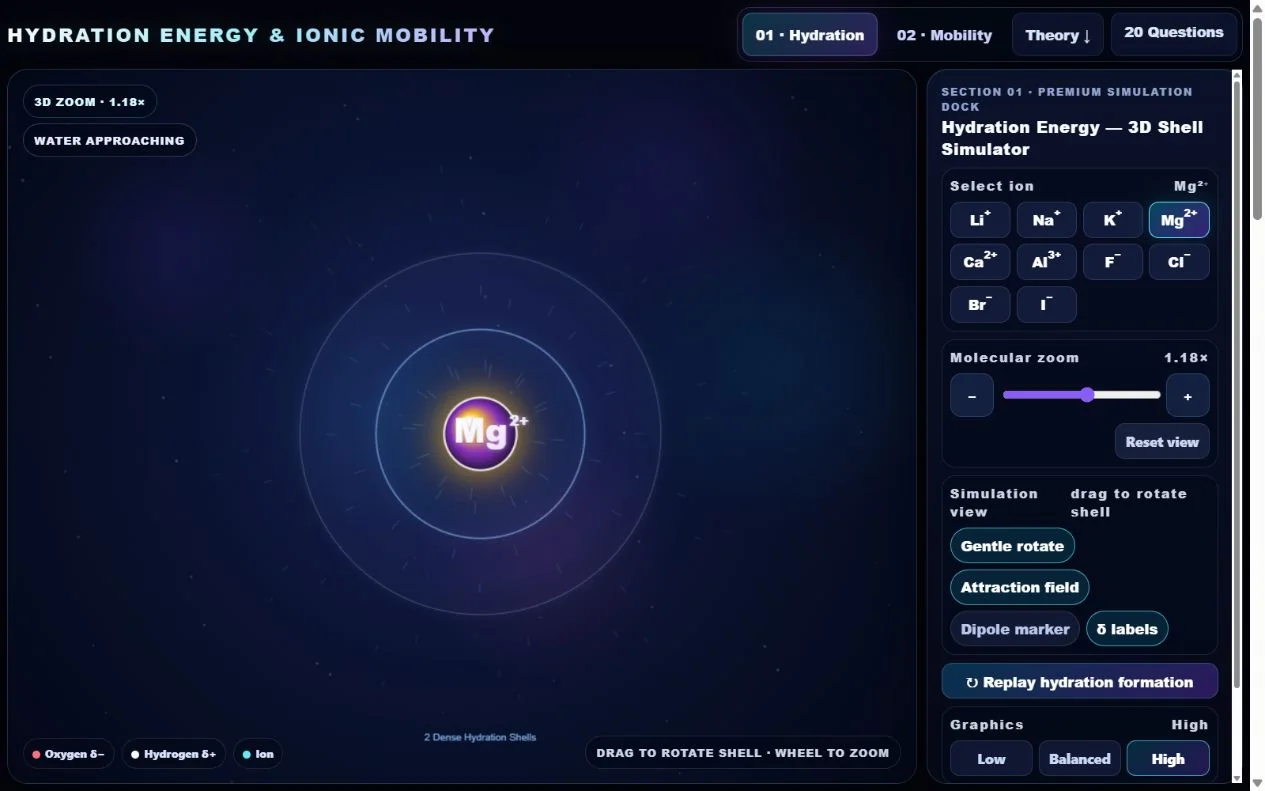 Electrochemistry
Watch water dipoles approach, orient and lock around an ion in a rotatable 3D hydration shell, then compare realistic hydrated-ion motion in an electric field.
Open related lab →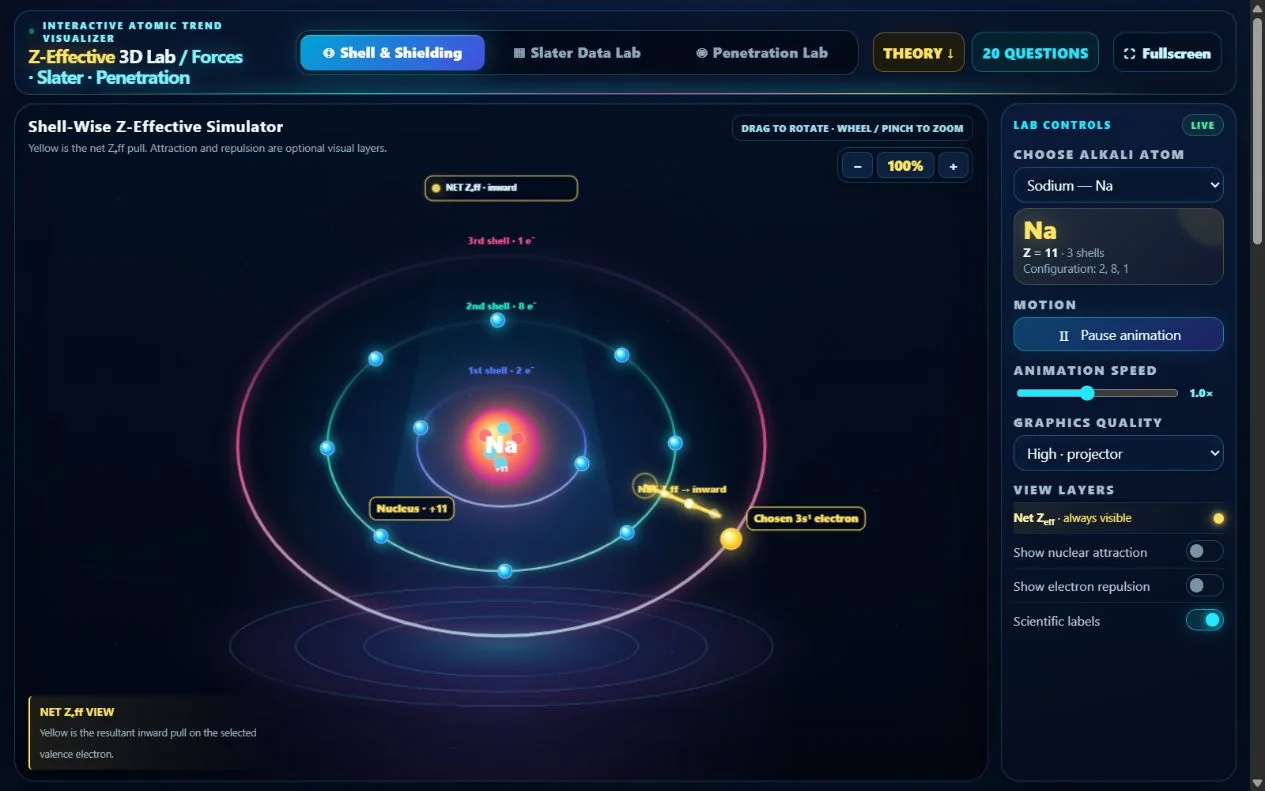 Atomic Structure
Visualise effective nuclear charge as nuclear attraction minus shielding, apply Slater's rules across Period 2 and Group 1, and compare s, p, d and f penetration.
Open related lab →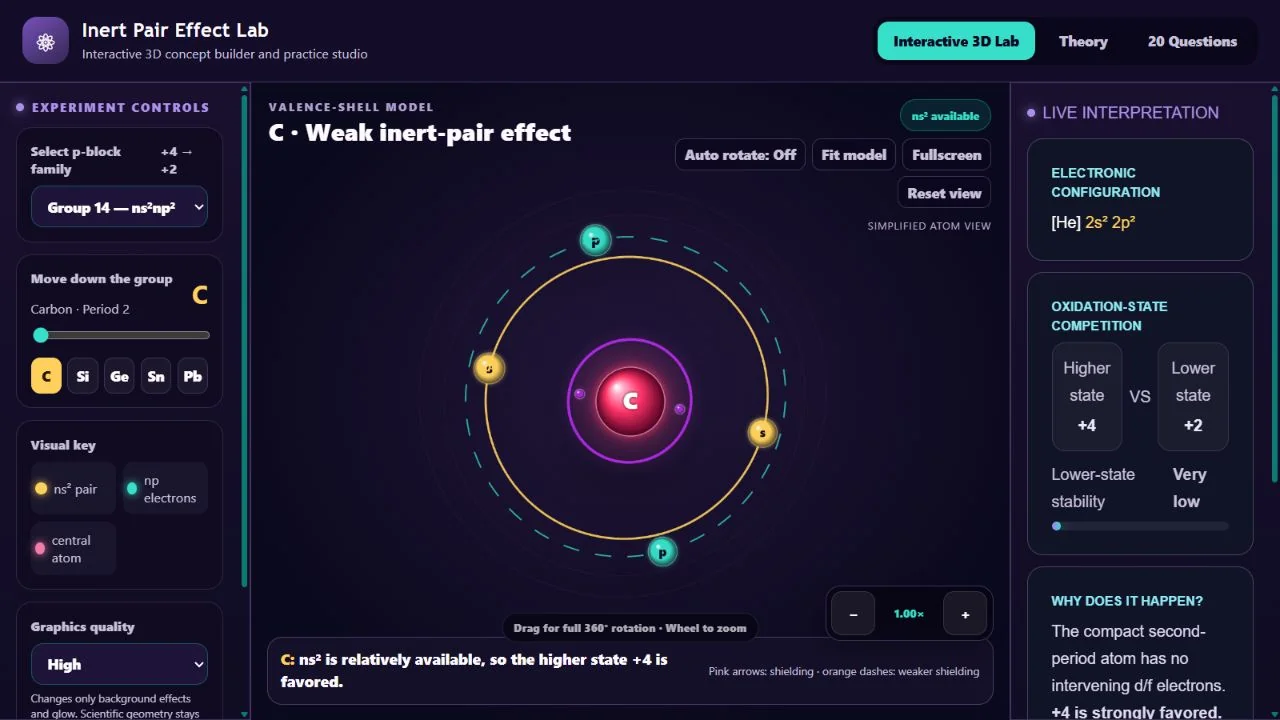 p-Block Elements
Visualise why the ns² electron pair participates less down Groups 13–15, compare lower and higher oxidation states, and solve guided practice questions.
Open related lab →Connect this lab with related chemistry topics and choose the depth that fits your current studies.
STUDENT DISCUSSION
Loading discussion…
Comments stay outside the simulation. When you exit the lab, you can choose to share a question or observation.